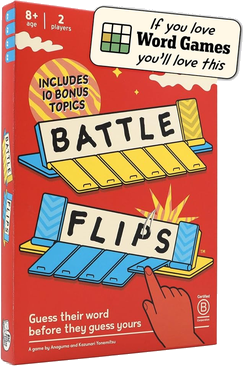
For a big group, Herd Mentality is the safest buy on this list. It runs from 4 players to 20 without changing how it plays, and everybody answers every round, so nobody is stuck watching. If your crowd is closer to ten and wants something with teeth, Deception: Murder in Hong Kong handles up to 12. For teams, it’s Tilt ‘n’ Shout.
Finding board games for large groups is harder than it should be. Most boxes cap out at four or five players. The ones that claim to go higher usually manage it by making seven people wait their turn, which is how you end up with three separate conversations and a game nobody finishes.
The games worth owning solve this in one of two ways. Either everybody acts at the same time, or the whole table’s talking at once because that’s the point. Every board game for large groups below does one of those. We’ve listed the real player ceiling for each, and where a game gets worse as it scales up, we’ve said so.
Quick picks
- Best Overall: Herd Mentality
- Best for Teams: Tilt ‘n’ Shout
- Funniest: You Can’t Say Umm
- Best for 10+ People: Deception: Murder in Hong Kong
- Best Drawing Game: Telestrations
- Best Deduction Game: Codenames
- Also great: Sounds Fishy
- Also great: One Night Ultimate Werewolf
- Also great: The Resistance: Avalon
- Also great: Chicken vs Hotdog
Herd Mentality
Best Overall
Twenty people, one question, and no reason for any of them to wait.
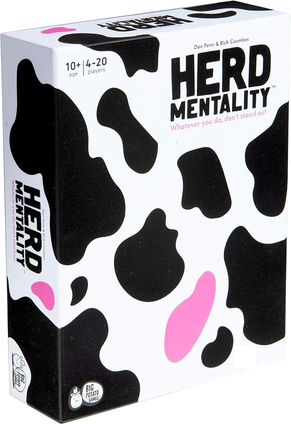
Players: 4–20 | Ages: 10+ | Play time: about 20 minutes
A question gets read out. Name something you’d find in a garage. Everybody writes an answer on their own pad and reveals at once. Match the majority and you take a cow token, and eight cows wins the game.
The reason it tops a list of board games for large groups is structural. Every player answers every round, so the game doesn’t get slower as the table gets bigger. It actually gets better, because guessing the majority is a harder and funnier problem with fifteen people than with five.
Answer on your own and you pick up the Pink Cow, a foam penalty piece that stops you winning until somebody else goes solo. In a big room that thing moves around constantly, which is exactly what you want.
Pros
- Twenty players with no change to the rules
- Everybody answers every round, so there’s no downtime at all
- Teaches in about a minute, which matters with a full room
Cons
- You need a pad and pencil per person, so check the box is complete
- Reveals take longer with 15+ players
- Handwriting gets hard to read across a big table
Tilt ‘n’ Shout
Best for Teams
A seesaw, a rolling ball, and your entire team screaming a category at you.
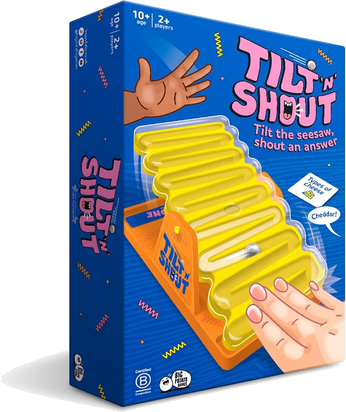
Players: 2+ in two teams | Ages: 10+ | 150 category cards
Two teams sit at opposite ends of a plastic seesaw with a ball on it. Flip a category card, shout an answer, and tilt the seesaw toward your side. That sends the ball rolling at the other team, who have to shout a different answer before it drops into their losing zone.
Because it’s team-based, the player count is however many people you can fit on two sides of a table. Only one person from each team’s answering at a time, but the rest are shouting suggestions, which means a group of twelve stays fully involved.
Win four rounds and your block reaches the winning zone. The clever part is the Roadblock to Victory: as the leading team gets closer, the ball rolls slower in their direction, so a runaway lead gets harder to hold. There are 150 category cards in the box.
Pros
- Team format means there’s no real player ceiling
- Physical and loud, which suits a crowded room
- The catch-up mechanic keeps a big group from checking out early
Cons
- Only one player per team answers at a time
- The seesaw takes up real table space
- Not the one to pick if your group wants something calm
You Can’t Say Umm
Funniest
Describe it in 45 seconds. Say “umm” once and the other team rings a bell at you.
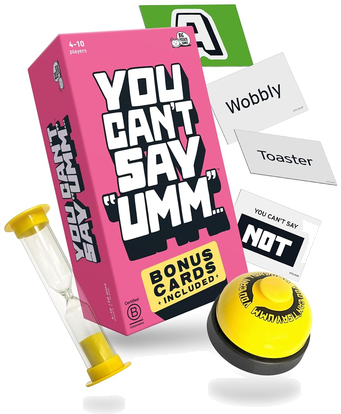
Players: 4–10 | Ages: 8+ | Play time: 45 seconds a round
One player describes pairs of words to their team against a 45-second timer. The opposing team sits opposite holding a bell. Every time the describer says umm, ah, or anything else that counts as a slip, they ring it and move their own piece forward.
Handing the bell to the other team is the whole design. It gives the people who aren’t describing a job, which is the thing most party games forget at eight or nine players. Nobody is waiting for a turn, because half the room is actively hunting for a mistake.
Get far enough along the board and you hit Rule Cards, which add a restriction your team has to live with for the rest of the game. Reach the last few spaces and you’re in the Danger Zone, where even the guessers can’t say umm. There’s a sand timer in the box and a free app if you’d rather use your phone.
Pros
- The bell gives the non-describing team something to do
- Rounds are 45 seconds, so the pace never sags
- Rated 8+, so it works with a mixed-age crowd
Cons
- Caps at 10 players
- An odd number needs somebody to referee
- Genuinely hard, and some people hate being the describer
Deception: Murder in Hong Kong
Best for 10+ People
The murderer is helping you interpret the evidence. That’s the problem.
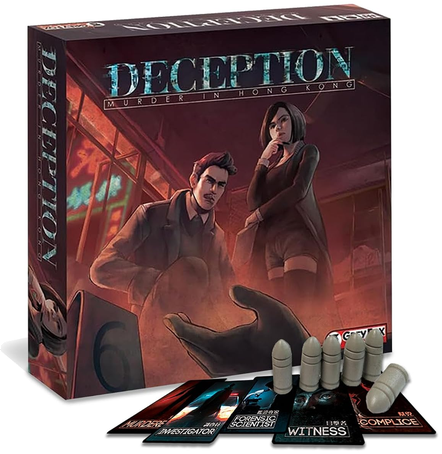
Players: 4–12 | Play time: about 20 minutes
One player is secretly the murderer and one is the forensic scientist. The murderer silently picks their weapon and a piece of key evidence from the cards laid out in front of the players. The scientist knows what both are and may only point at abstract scene tiles to say so.
Everyone else argues about what the tiles mean. The catch is that the murderer is sitting right there in the conversation, helping to interpret clues that describe their own crime, and usually doing it very convincingly.
It goes to 12, which makes it the highest ceiling on this list and the reason it’s here. A round takes about twenty minutes, so a big group can run three or four in an evening and it won’t drag.
Pros
- Handles up to 12 players, more than anything else here
- Everyone is talking at once, which suits a crowded room
- Rounds are short enough to replay immediately
Cons
- Needs a big table for the card layout
- The scientist role is hard, and a bad one ruins the round
- Takes a few minutes to teach, unlike most picks here
Telestrations
Best Drawing Game
Telephone, but with your terrible drawing as the message.
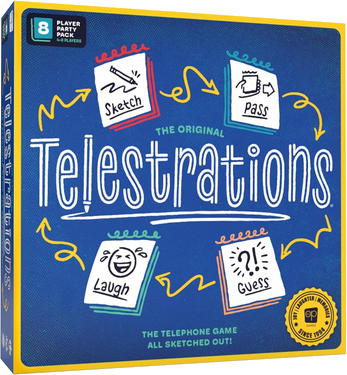
Players: 4–8 | Ages: 10+ | Play time: about 30 minutes
Everybody gets a booklet and a secret word. You draw it, pass the booklet on, and the next person writes what they think your drawing is. Then they pass it again and somebody draws that guess.
Every player’s sketching at the same moment, so eight people play as fast as four. That’s the one property every game on this list needs, and it’s what most drawing games don’t have.
The payoff is the reveal at the end, when everyone walks their booklet back through the chain and finds out that a horse became a lawyer in four steps. It’s officially 4 to 8, and the party pack editions go higher if your group regularly breaks eight.
Pros
- Everyone draws simultaneously, so it never slows down
- Drawing badly is funnier than drawing well
- The end-of-game reveal is the best moment of any game here
Cons
- The base box caps at 8
- Dry-erase pens wear out and need replacing
- People who hate drawing really hate it
Codenames
Best Deduction Game
One word, one number, and two teammates about to pick the assassin.
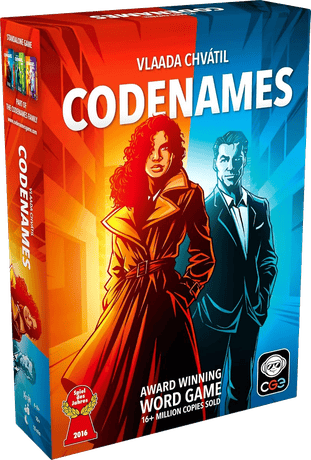
Players: 4+ in two teams | Play time: about 15 minutes
Twenty-five word cards sit in a five by five grid. Each team has a spymaster who knows which cards belong to their side, and who gives a one-word clue plus a number. The number says how many cards that clue covers.
Their team then guesses, up to the number plus one. An innocent bystander ends your turn. Pick the other team’s agent and you’ve just helped them win. Touch the assassin and it’s over instantly, which is where most of the shouting comes from.
It handles a large group because only two people have a formal job. Everybody else is a teammate arguing about what the clue meant, and that argument gets better with six on a team, not worse. The 2nd Edition has a revised word list and a cleaner rulebook.
Pros
- No real upper limit, since extra players just join a team
- Teaches in two minutes and plays in fifteen
- The arguing is the game, so a loud room helps
Cons
- The spymaster job is much harder than the rest
- One dominant player can talk over a whole team
- Needs a fairly large flat surface for the grid
Sounds Fishy
Say your made-up answer out loud, to their faces, and don’t blink.
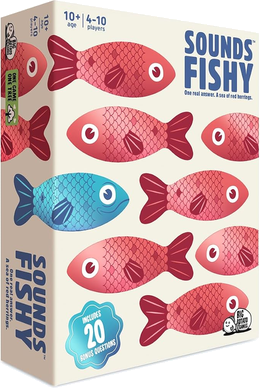
Players: 4–10 | Ages: 10+ | Play time: about 20 minutes
A question is read out that nobody could reasonably know. One player is the guesser. Of everyone else, exactly one is handed the real answer on a card, and the rest have to invent something convincing.
Nothing’s written down. You say your made-up answer out loud, in your own voice, while the guesser watches you do it. That’s a very different and much more exposing thing than writing a lie on a slip of paper.
It works at ten because every non-guesser has to perform. The bigger the group, the more answers the guesser has to sort through, and the more chances somebody has to oversell theirs.
Pros
- Everyone except the guesser has an active job
- No writing, so it moves quickly with a big group
- Gets funnier as the group gets bigger
Cons
- Caps at 10 players
- Shy players find saying a lie out loud genuinely hard
- Needs four minimum, so it’s no good for a small group
One Night Ultimate Werewolf
One night, one vote, ten minutes, and nobody gets knocked out.
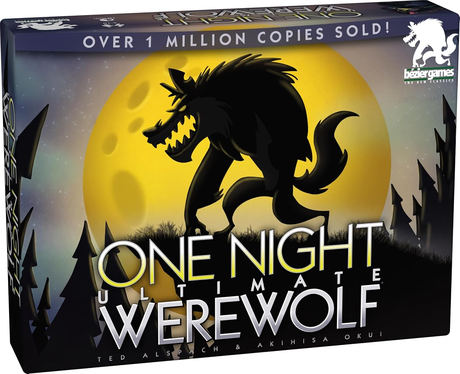
Players: 3–10 | Play time: about 10 minutes
Everyone takes a hidden role. Seer, Troublemaker, Robber, Werewolf and so on. There’s a single night phase where those roles quietly act, then one discussion, then one vote.
The thing that makes it work for a big group is that nobody’s eliminated. Classic Werewolf knocks people out and leaves them watching for half an hour, which is miserable at a party. This one’s over in ten minutes and everyone plays all of it.
Roles get swapped around during the night, so you can end the game as something you didn’t start as. That means even the werewolf is sometimes genuinely unsure, which keeps the discussion honest.
Pros
- Nobody is eliminated, so no one sits out
- Ten minutes a game, so you can run five in a row
- Goes to 10 players out of the box
Cons
- Needs a free app or a narrator for the night phase
- Quiet groups struggle, since the whole game is the discussion
- The role list takes a round or two to learn
The Resistance: Avalon
Merlin knows who the bad guys are. Merlin also cannot say a word.
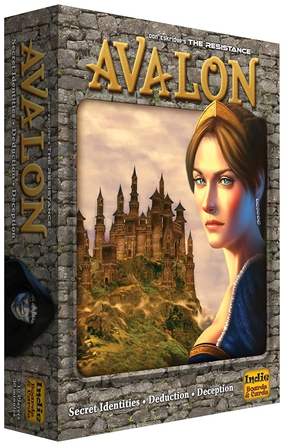
Players: 5–10 | Ages: 13+ | Play time: about 30 minutes
The table splits into loyal servants and Mordred’s hidden minions. Each round a leader proposes who goes on the quest, everyone votes on whether to approve that team, and the players sent secretly choose success or failure.
What separates it from most hidden-role games is that the evidence is real. A failed quest proves somebody on that team sabotaged it, so the group’s arguing about facts rather than vibes. Five rounds decide the game.
Merlin is why it stays tense. The good side has one player who knows exactly who the traitors are and cannot say so, because if the traitors work out who Merlin is at the end, they win anyway.
Pros
- Real evidence to argue over, not just suspicion
- Scales cleanly from 5 to 10 without breaking
- The Merlin role gives the good team a genuine puzzle
Cons
- Needs at least five, so it’s useless for a small group
- Thirty minutes is long if your group is drifting
- Rated 13+, so it’s not one for a family crowd
Chicken vs Hotdog
Two teams, one rubber chicken, and thirty reasons to get off the sofa.
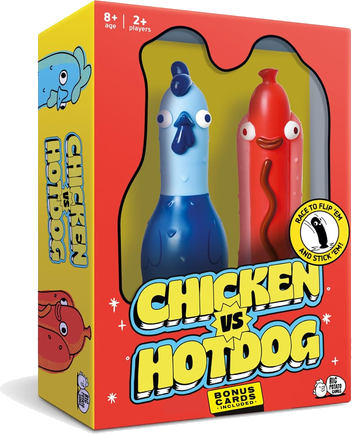
Players: 2–10 | Ages: 8+ | Play time: about 20 minutes
Two teams bid for the right to attempt a challenge, then flip their rubber chicken or hotdog, the Sling’Ems, and try to stick the landing. There are 30 challenges and they get progressively more ridiculous.
Play the same card as your opponent and you trigger Flip-o-Rama, where both teams go at once and the first to land it takes the round. With ten people that turns into a genuine crowd event rather than a turn-taking game.
It’s the pick for when a big group has been sitting down too long. Everything else on this list happens at a table. This one needs floor space, and it’s usually the thing that resets the energy in a flagging room.
Pros
- Gets a big group standing up and moving
- Team play means weaker players are carried
- Works from 2 players right up to 10
Cons
- Needs clear floor space and nothing breakable
- Loud enough to be a problem in an apartment
- Physical skill matters, which not everyone enjoys
How the best board games for large groups compare
Herd Mentality vs Codenames for a group of ten
Both handle ten people, and they do it in opposite ways. Herd Mentality gives every single player a pad and a job every round. Codenames gives two players a hard job and turns the other eight into two arguing committees. Of the board games for large groups here, one’s inclusive by design and the other’s better if your group likes debating.
Verdict: Pick Herd Mentality if the group doesn’t know each other well. Pick Codenames if they do and they’re competitive.
Deception vs Avalon for a deduction night
These are the two serious deduction picks here. Deception goes to 12, plays in twenty minutes and gives the group real evidence in the form of scene tiles. Avalon caps at 10, runs thirty minutes and builds across five quests, so betrayals land harder because you’ve watched them coming.
Verdict: Pick Deception if the group is above ten or new to deduction. Pick Avalon if you’ve got 5 to 10 people who want a longer game.
Tilt ‘n’ Shout vs Chicken vs Hotdog for teams
Both are team games with no real player ceiling, and both are loud. Tilt ‘n’ Shout is a category game with a physical timer, so it rewards quick thinking. Chicken vs Hotdog is pure physical skill and needs floor space rather than table space.
Verdict: Pick Tilt ‘n’ Shout if you want teams sitting at a table. Pick Chicken vs Hotdog if you want them on their feet.
How we chose these board games for large groups
The test for board games for large groups is simple: what is everyone who isn’t currently taking a turn actually doing? If the answer is waiting, the game doesn’t belong on this list no matter what the box claims. Every pick here either has all players acting at once, or makes the whole table talk at the same time on purpose.
You’ll notice four social deduction games in the ten. That’s not a preference, it’s a consequence. Deduction is one of the few formats that genuinely improves as you add people, because more players means more suspects and a better argument. Simultaneous-action games are the other format that scales, which is why Herd Mentality and Telestrations are here.
Player ceilings are taken from each game’s current listing or rulebook, not from the marketing copy. Where a box caps lower than you’d hope, it’s in the cons. Telestrations stops at 8 and You Can’t Say Umm stops at 10, and we’d rather say that than let you find out with twelve people in the kitchen.
This update replaces an earlier version of this guide. Two picks were dropped because they’re no longer reliably sold in both the US and the UK, which is a requirement for everything we recommend.
Player counts and age ratings checked against Big Potato Games, Czech Games Edition, Bezier Games, USAopoly.
Board games for large groups: frequently asked questions
What board game works with 10 people?
Several here do, but they feel different. Herd Mentality is the easiest call because it runs to 20 players and everybody writes an answer every round, so ten people means zero waiting. Deception: Murder in Hong Kong handles 4 to 12 and is the pick if your group wants something with real tension. One Night Ultimate Werewolf also reaches 10 and takes about ten minutes a game. You Can’t Say Umm caps at exactly 10, so it just squeezes in. Avoid Telestrations at ten, since the base box stops at 8 players.
What’s the best party game for a big group that doesn’t know each other?
Go with something where being wrong is funny rather than embarrassing. Herd Mentality is the strongest opener for 4 to 20 players, because the answers are mundane and nobody has to perform. Telestrations works well too at 4 to 8, since a bad drawing is a shared joke rather than a personal failure. Hold back the deduction games at first. Codenames and Avalon both reward reading people, and a room of strangers has nothing to read yet, so they land much better an hour into the evening than at the start.
Which board games for large groups have no waiting around?
Look for simultaneous play. Herd Mentality has all 4 to 20 players writing at the same moment, and Telestrations has all 4 to 8 drawing at once, so neither slows down as you add people. The talking games get there a different way: in Codenames and Deception: Murder in Hong Kong the whole table argues at once, so there’s no dead time even at 12 players. The ones to watch are the turn-based board games for large groups. Tilt ‘n’ Shout has one player per team answering at a time, though their teammates are shouting suggestions throughout, so it doesn’t feel like waiting.
Can you play board games with 15 or 20 people?
Only a handful genuinely work at that size. Herd Mentality is the main one, rated for up to 20 players with no rule changes needed. Tilt ‘n’ Shout has no fixed ceiling either, since it’s two teams of any size, and Chicken vs Hotdog works the same way at 2 to 10 in teams. Codenames technically scales too, because extra people just join a team. Everything else on this list has a hard cap between 8 and 12. With 20 people, the honest advice is to run two games at once rather than force one.
Are deduction games good for large groups?
They’re one of the best formats for it, which is why four of these ten are deduction games. More players means more suspects, longer arguments and better bluffing, so the game genuinely improves rather than just tolerating the extra people. Deception: Murder in Hong Kong is the biggest at 4 to 12 players. One Night Ultimate Werewolf goes to 10 and takes ten minutes. The Resistance: Avalon runs 5 to 10 and is the longest at about thirty minutes. The one requirement is a group willing to talk, because a quiet table kills all three.
If you’re buying one game for a big crowd, Herd Mentality’s the safe answer, and it stays useful whether six people turn up or sixteen. Add Deception: Murder in Hong Kong if your group likes an argument, and Chicken vs Hotdog for the point in the night when everyone needs to get off the sofa.