The best board game for an Easter basket is OK Play. It’s smaller than a paperback, it clips onto a bag, and the waterproof tiles survive being buried under chocolate. If the child is under eight, Taco Cat Goat Cheese Pizza is the better call. And if you want the cheapest thing that still holds a whole family’s attention, I’m Gonna Risk It is a single deck of cards.
The hard part about board games for Easter baskets isn’t finding a good game. It’s finding one that physically fits, costs about the same as a chocolate egg, and doesn’t need four people and an hour to be worth opening.
That rules out most of the shelf. What’s left is small boxes, card games and a couple of things designed to be carried rather than stored. The board games for Easter baskets below are all genuinely basket-sized apart from one, which we’ve flagged because it’s a great game and you might want it anyway.
Quick picks
- Best Overall: OK Play
- Best for Younger Kids: Taco Cat Goat Cheese Pizza
- Smallest: I’m Gonna Risk It
- Best Word Game: Pounce
- Best Co-op: The Mind
- Best Quick Filler: Sushi Go
- Also great: Cards vs Gravity
- Also great: Chicken vs Hotdog
OK Play
Best Overall
Five in a row, waterproof tiles, and it clips onto a school bag afterwards.
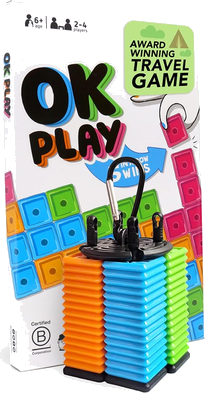
Players: 2–4 | Ages: 8+ | Play time: about 15 minutes
Pick a color, take your stack of tiles, and lay them down. First to make a line of five in any direction wins. That’s the entire rulebook, which is why a child can open it and start playing without an adult reading anything.
It’s the right shape for a basket. Smaller than a paperback, nothing loose to spill, and the tiles are waterproof, so being buried under foil-wrapped eggs for a morning does it no harm at all.
The part that makes it last past Easter Sunday is the carabiner clip. Of all the board games for Easter baskets we looked at, this is the one most likely to end up on a school bag rather than in a cupboard.
Pros
- Small, solid and nothing to spill
- Waterproof tiles
- Clips to a bag, so it gets used after the holiday
Cons
- Caps at four players
- Pure strategy, so there’s no silliness in it
- Two well-matched players can grind to a draw
Taco Cat Goat Cheese Pizza
Best for Younger Kids
Say the word, flip the card, slap the pile. Rated 7 and up.
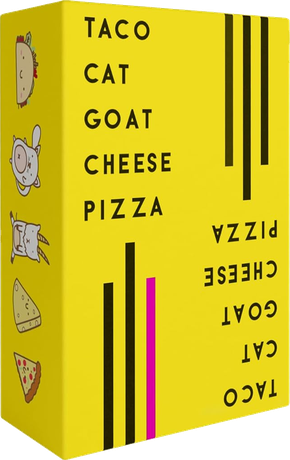
Players: 2–8 | Ages: 7+ | Play time: 10 to 15 minutes
Players flip cards in turn while everyone chants taco, cat, goat, cheese, pizza. When the word matches the card that just landed, the whole table races to slap the pile, and the slowest hand takes the cards.
It’s the youngest-friendly pick here at 7 and up, and it’s the one where being a child is genuinely no disadvantage. It’s pure reaction, so nothing an adult knows helps them, and the sight of a grown-up slapping the wrong card is the whole appeal.
The deck is tiny, it costs about the same as a decent chocolate egg, and a game takes ten minutes. It handles up to 8 players too, so it survives the bit of Easter Sunday where the cousins arrive.
Pros
- Rated 7+, the youngest pick on this list
- Tiny deck, no loose pieces
- Goes to 8 players when the family turns up
Cons
- Loud, and it involves slapping a table
- Cards wear out with heavy use
- Almost no strategy in it
UK buyers: the Amazon UK listing is the Blue Orange edition of the same game.
I’m Gonna Risk It
Smallest
One deck, one rule, and a decision to make every turn.
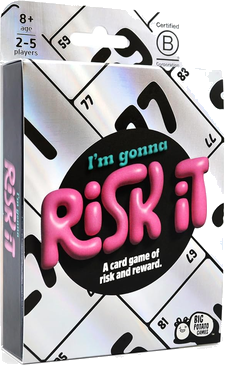
Players: 2–5 | Ages: 8+ | Play time: about 15 minutes
There’s one rule. The card you take has to be higher than the card you took last. Keep going as long as you dare, and the second you can’t beat your own last card you’re out of the round and you lose the lot.
It’s the smallest thing here and close to the cheapest, which makes it the obvious filler when you’re buying for several children at once. There’s no board and nothing to lose under the sofa.
What you get for the size is a real decision every turn. You’re sitting on four cards and the next one is a 63, so do you bank or push? Playing it safe loses just as reliably as getting greedy, which is why it doesn’t wear out after one afternoon.
Pros
- Smallest and cheapest pick here
- Teaches in one sentence
- Real decisions, not just luck
Cons
- Luck still plays a part
- No art or theme to speak of
- Caps at five players
Pounce
Best Word Game
One word, one letter, right now. No spelling-bee energy required.
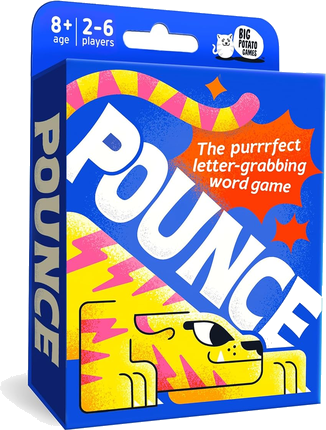
Players: 2–6 | Ages: 8+ | Play time: about 15 minutes
Letters go out on the table and a category comes up. Shout a word that fits the category and starts with one of those letters, then grab that letter card. Collect enough to spell a five-letter word and you’ve won.
The scoring is what makes it work for a family rather than just the quickest thinker. Every player takes a card each round except the slowest one, so you’re racing not to be last rather than racing to be first, and nobody gets left behind.
It’s the word game on the list that doesn’t feel like homework, which matters if you’re sneaking something educational into a basket. The categories run broad enough that a ten-year-old and a grandparent both stand a chance.
Pros
- Vocabulary without the spelling-test feeling
- The not-last scoring keeps slower players in it
- Pocket-sized
Cons
- Needs reading, so it’s no good below about eight
- A quick thinker still has an edge
- It’s a shouting game, so not a quiet one
The Mind
Best Co-op
Play the cards in order without speaking. Nobody loses on their own.
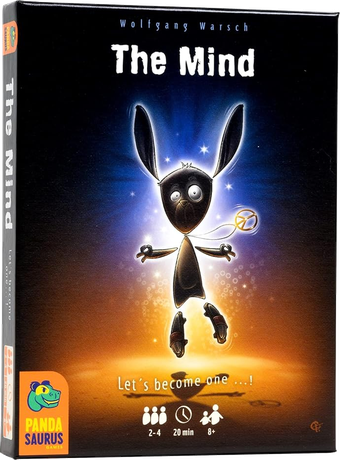
Players: 2–4 | Ages: 8+ | Play time: about 20 minutes
You hold a hand of numbered cards and the group has to play them all in ascending order. You aren’t allowed to speak, gesture or communicate about what you’re holding in any way.
It’s the pick for a child who takes losing badly, because there’s nobody to lose to. You win or lose as a group, and a failed level is everyone’s fault rather than one person’s.
The box is tiny and the rules take under a minute. What you get is twenty minutes of staring at a sibling trying to work out whether their silence means a low card or a slow one.
Pros
- Cooperative, so nobody goes to bed sulking
- Very small box
- Rules explain in under a minute
Cons
- A round can collapse in seconds
- Some children find the no-talking rule maddening
- Not much to it if the tension doesn’t land
UK buyers: the English UK edition is the Asmodee/NSV release. Avoid the German-language base game, which also shows up in UK search results.
Sushi Go
Best Quick Filler
Pick one, pass the rest, and quietly take the card your brother wanted.
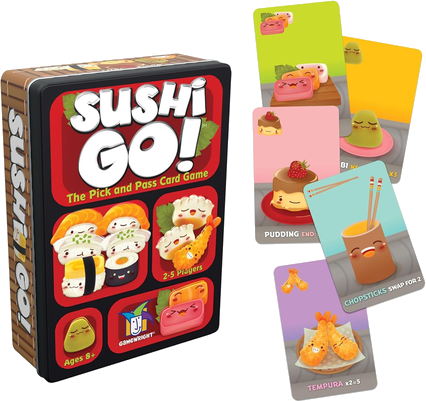
Players: 2–5 | Ages: 8+ | Play time: about 15 minutes
You get a hand of cards, keep one, and pass the rest to the person beside you. Repeat until the cards run out, score, then do it twice more. Sashimi only pays if you finish three of them, and puddings settle right at the end.
It arrives in a tin about the size of a paperback, so it sits in a basket without dominating it. Everyone chooses at the same moment, which means five players move as fast as two and nobody sits waiting.
There’s more thinking in it than the cheerful art suggests. Working out what you’re about to hand your sibling, and what’s coming back around, is a genuine skill and children pick it up faster than adults expect.
Pros
- Tin the size of a paperback
- Simultaneous play, so no waiting
- More tactical than it looks
Cons
- Scoring needs a cheat sheet the first game
- Caps at five players
- Quieter than the rest of this list
Cards vs Gravity
Balance cards on a bottle until somebody’s hand shakes.
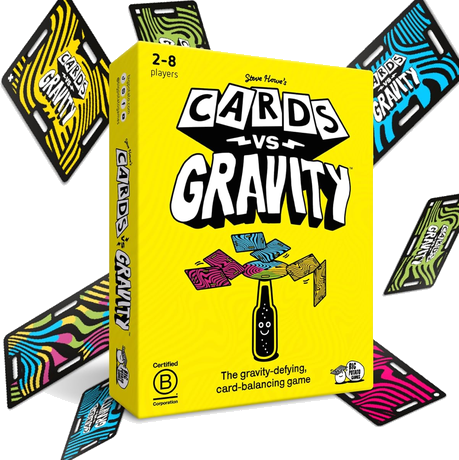
Players: 2–4 | Play time: about 10 minutes
You balance, hang and stack cards on top of a bottle. Any bottle will do, which is the clever part, because there’s always one on a table after a family lunch.
Steady hands beat clever thinking here, so it’s the one that levels the field between a child and an adult who wins everything else. Ten minutes a round, and the deck is small enough to disappear into a basket.
The cards are waterproof and marked with symbols as well as colors, so they work for color-blind players and survive being taken into the garden.
Pros
- Rewards steady hands rather than vocabulary
- Waterproof, with symbols as well as colors
- Ten minutes a round
Cons
- You need a bottle, so it isn’t self-contained
- A wobbly table ruins it
- Two to four players only
Chicken vs Hotdog
Flip a rubber chicken. Too big for the basket, worth it anyway.
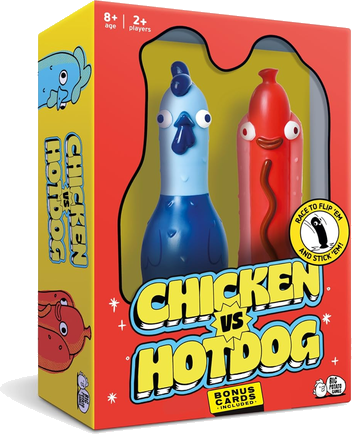
Players: 2–10 | Ages: 8+ | Play time: about 20 minutes
Two teams bid for the right to attempt a challenge, then flip a rubber chicken or hotdog, the Sling’Ems, and try to stick the landing. There are 30 challenges and they get steadily more ridiculous. Play the same card as your opponent and you trigger Flip-o-Rama, where both teams go at once.
Be clear about the size. This is the one pick here that will not fit in a basket, and pretending otherwise would waste your money. It’s a proper box with rubber figures in it.
It’s on the list because Easter weekend is usually two days of children indoors with too much sugar, and this is the thing that gets them off the sofa. If you’re buying one bigger present alongside the basket fillers, it’s the one we’d pick.
Pros
- Gets everyone standing up after lunch
- Works from 2 players up to 10
- Team play means younger kids are carried
Cons
- Too big for an actual basket, by some distance
- Loud, with no quiet version
- Needs floor space and nothing breakable nearby
How these board games for Easter baskets compare
OK Play vs Taco Cat Goat Cheese Pizza
These are the two strongest basket fillers and they split neatly on age. OK Play is rated 8 and up, plays 2 to 4, and rewards thinking a move ahead. Taco Cat is rated 7 and up, goes to 8 players, and rewards nothing but reflexes.
Verdict: Pick OK Play for a child of eight or over who likes a puzzle. Pick Taco Cat for anyone younger, or for a house full of cousins.
I’m Gonna Risk It vs Sushi Go
Both are card games around the same size and price. I’m Gonna Risk It has one rule and a gamble every turn, so it’s the better pick for a child who won’t sit through an explanation. Sushi Go has real drafting tactics but needs a scoring cheat sheet for the first game.
Verdict: Pick I’m Gonna Risk It for instant play. Pick Sushi Go if the child is the sort who enjoys working a system out.
What actually fits in a basket
Seven of these eight genuinely do. OK Play, I’m Gonna Risk It, Pounce, Taco Cat, The Mind, Cards vs Gravity and Sushi Go are all a paperback or smaller, and most cost about what a mid-size chocolate egg does. Chicken vs Hotdog is the one exception on this list of board games for Easter baskets, and it’s a full-size box.
Verdict: Fill the basket from the first seven. Buy Chicken vs Hotdog as the separate thing you open after lunch.
How we chose these board games for Easter baskets
The filter for board games for Easter baskets is physical before it’s anything else. If it doesn’t fit next to the eggs, it isn’t a basket game, however good it is. Seven of these eight are a paperback or smaller, and where a pick fails that test we’ve said so in its own entry rather than letting you find out at the checkout.
Price mattered nearly as much. Most of these sit in the same bracket as a decent chocolate egg, which is the point when you’re buying for more than one child.
We also looked for games a child can open and start without an adult reading a rulebook first. Easter morning is not the moment for a setup phase, so everything here teaches in a couple of minutes at most.
Player counts and ages come from each game’s current listing. Everything is checked as available in both the US and the UK, which removed several picks from the previous version of this guide.
Player counts and age ratings checked against Big Potato Games, Gamewright, Pandasaurus Games.
Board games for Easter baskets: frequently asked questions
What board games fit in an Easter basket?
Seven of the eight board games for Easter baskets here are a paperback or smaller. OK Play is the pick of them, a waterproof tile game for 2 to 4 players aged 8 and up that also clips onto a bag afterwards. I’m Gonna Risk It and Pounce are both single decks, for 2 to 5 and 2 to 6 players. Taco Cat Goat Cheese Pizza and The Mind are similarly tiny, and Sushi Go comes in a paperback-sized tin. The one to avoid if space is the issue is Chicken vs Hotdog, which is a full-size box with rubber figures in it.
What’s a good Easter game for a 7 year old?
Taco Cat Goat Cheese Pizza, rated 7 and up for 2 to 8 players. It’s a slapping reaction game, so a seven-year-old competes with adults on completely level terms and frequently wins. Everything else on this list is rated 8 and up, including OK Play, I’m Gonna Risk It, Pounce, The Mind and Sushi Go, so with a younger child those are worth holding back for a year. Cards vs Gravity is the other good option for a young child, since it’s about steady hands rather than reading or vocabulary.
Are there Easter games that work for the whole family?
The basket fillers mostly cap at four or five players, which is the thing to watch when relatives arrive. Taco Cat Goat Cheese Pizza goes to 8 and Pounce goes to 6, so those two cover a bigger table. Chicken vs Hotdog handles 2 to 10 in teams and is the one that gets people up and moving after a long lunch, though it’s a full-size box rather than a basket filler. OK Play, Sushi Go, The Mind and Cards vs Gravity all stop at four or five players.
What’s the cheapest board game for an Easter basket?
I’m Gonna Risk It is the smallest and among the cheapest, a single deck with one rule for 2 to 5 players aged 8 and up. Taco Cat Goat Cheese Pizza sits in the same bracket and reaches 8 players. Both cost roughly what a mid-size chocolate egg does, which matters when you’re filling several baskets at once. We don’t publish prices here because they move constantly, so check the live listing, but those two are consistently the least expensive picks on this list.
If you’re filling one basket, put OK Play in it. It’s small, it’s tough, it teaches in ten seconds and it ends up clipped to a school bag rather than in a cupboard. Swap in Taco Cat Goat Cheese Pizza if the child is younger than eight. And if you want something for the whole family after lunch rather than more board games for Easter baskets, buy Chicken vs Hotdog separately.