If you want the closest thing to Codenames, buy The Chameleon. It’s the same trick of saying one careful word while the table studies your face, except there’s a liar at the table instead of a spymaster. If what you actually liked was the teamwork, Just One is the better swap. And if you liked being suspicious of everyone, go to Deception: Murder in Hong Kong.
People looking for games like Codenames are usually chasing one of two very different things. Either it’s the word puzzle, where a spymaster says one word plus a number and two teammates have to work out what on earth they meant. Or it’s the social part, where you’re watching somebody’s face and trying to figure out if they’ve understood you or not.
Those want different replacements, so this list covers both. Every pick below is sold in the US and the UK, and each one says plainly which part of Codenames it’s standing in for.
The five picks at a glance
- Closest swap for Codenames: The Chameleon
- Best cooperative alternative: Just One
- Best for bigger groups: Deception: Murder in Hong Kong
- Best for hidden roles: One Night Ultimate Werewolf
- Best for thinking like the group: Herd Mentality
The Chameleon
Closest swap for Codenames
Say one word about a thing you can’t see, and try not to sound like you’re guessing.
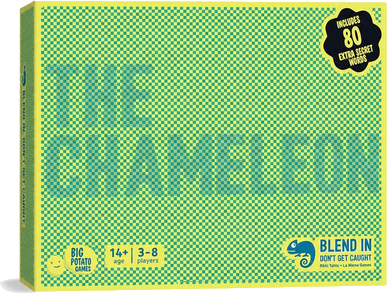
Players: 3–8 | Ages: 12+ | Play time: about 15 minutes
A topic card lays out sixteen related words in a grid. Roll the dice, check your code card, and it points you at one of them. Everybody does this except one player, who draws the Chameleon card and is told nothing at all.
Then each person says a single word about the secret word. That’s the bit that will feel immediately familiar if you’ve played Codenames. Too specific and you hand the answer to the Chameleon. Too vague and the table decides you are the Chameleon, which is how innocent people get voted out.
The difference is where the pressure sits. Codenames puts one clever person under the spotlight as spymaster. The Chameleon puts everybody under it at once, every single round, and there’s no moderator and no app to run. There are 800 topics in the box and a game takes about fifteen minutes.
Pros
- Same one-careful-word tension, without needing a spymaster
- 800 topics, so it lasts
- Nobody is eliminated, so everyone plays every round
Cons
- Caps at 8 players, where Codenames has no real ceiling
- Rated 12+, so it’s less of a family pick
- Three players is technically allowed but thin
Just One
Best cooperative alternative
Write the perfect clue. Have it deleted because two of you thought of it.
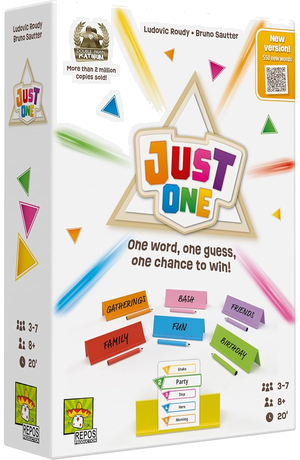
Players: 3–7 | Ages: 8+ | Play time: about 20 minutes
One player guesses. Everyone else sees the secret word and writes a single one-word clue on a dry-erase holder. Any clue that two or more people wrote gets pulled before the guesser is allowed to look.
That rule turns the Codenames problem inside out. In Codenames you’re trying to find the cleverest connection. Here you’re trying to find the clue that’s useful but that nobody else will think of, and watching three people independently write the obvious word is reliably the funniest moment of the game.
It’s fully cooperative, so there are no teams and nobody’s competing with you. Of the games like Codenames here, this is the one that keeps the moment your teammate finally gets it, which for plenty of groups was always the best part.
Pros
- Keeps the one-word-clue puzzle almost exactly
- Cooperative, so a mismatched group still has fun
- Rated 8+, the most family-friendly pick here
Cons
- No teams and no rivalry, if that’s what you wanted
- Caps at 7 players
- Needs everyone to be able to write quickly
Deception: Murder in Hong Kong
Best for bigger groups
Someone at this table killed a man and is now helping you read the evidence.
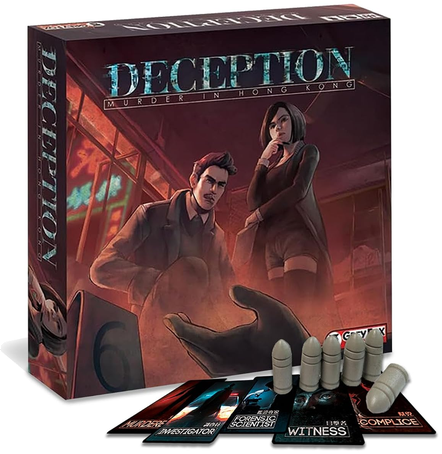
Players: 4–12 | Play time: about 20 minutes
One player is secretly the murderer, and one is the forensic scientist who knows exactly who did it. The scientist can’t speak freely. They can only place markers on abstract scene tiles, pointing at things like the cause of death and the location, and let the group interpret them.
That constraint is the Codenames spymaster problem wearing a different hat. One person holds the answer, has to communicate it through a deliberately narrow channel, and has to watch the group misread it. The difference is that here, the murderer is in the room helping everyone misread it.
It takes 4 to 12 players, which is the reason it’s on this list. Codenames absorbs a big group easily, and most alternatives don’t. This one does, and a round runs about twenty minutes.
Pros
- Goes to 12 players, matching Codenames for a crowd
- Real evidence to argue over, not just a hunch
- Short rounds, so a bad one costs you twenty minutes
Cons
- Takes longer to teach than Codenames
- The forensic scientist role is genuinely difficult
- Needs a lot of table space for the tiles
One Night Ultimate Werewolf
Best for hidden roles
One night, one argument, one vote. Ten minutes and it’s done.
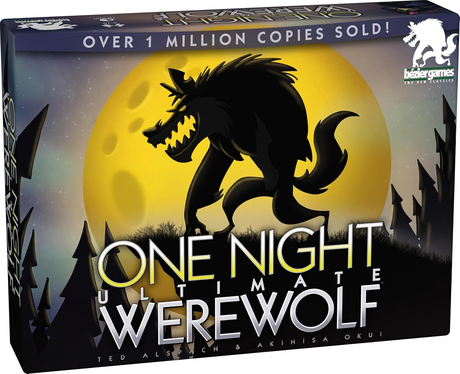
Players: 3–10 | Play time: about 10 minutes
Everyone takes a hidden role. Seer, Troublemaker, Robber, Werewolf. There’s one night phase where those roles quietly do their thing, then one discussion, then one vote, and the game is over.
This is the pick if the Codenames night you remember was mostly people accusing each other and laughing. It drops the word puzzle entirely and keeps the reading-the-room part, which for a lot of groups was always the actual draw.
Roles are swapped around during the night, so you can finish as something you didn’t start as. Nobody is eliminated and a game takes about ten minutes, so the group that wants one more round can have five.
Pros
- Ten minutes a game, faster than a round of Codenames
- Nobody is eliminated
- Goes to 10 players
Cons
- No word play at all, so it’s the furthest from Codenames here
- Needs a free app or somebody to narrate the night
- Falls flat with a quiet group
Herd Mentality
Best for thinking like the group
Stop being clever. Start being predictable. It’s harder than it sounds.
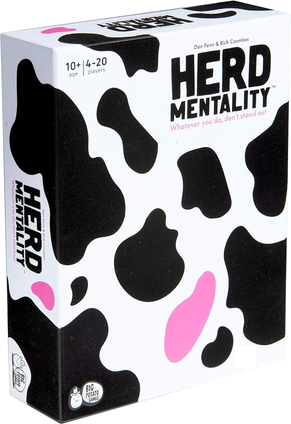
Players: 4–20 | Ages: 10+ | Play time: about 20 minutes
A question gets read out. Name a boring vegetable. Everyone writes their answer on a pad, you reveal together, and you score a cow token only if you matched the majority. Eight cows and you’ve won.
The connection to Codenames is narrower than the others here, and worth being straight about. It isn’t a deduction game and there’s no hidden information. What it shares is the core mental move: you’re not trying to find the right answer, you’re trying to find the answer other people will land on.
Where it beats Codenames outright is scale. It runs to 20 players with no rule changes, everybody writes at the same time, and it teaches in about a minute. If your Codenames nights kept collapsing because too many people turned up, this is the fix.
Pros
- Handles 4 to 20 players with no adjustment
- Teaches in about a minute
- Same guess-what-they’re-thinking muscle, no spymaster needed
Cons
- Not a deduction game, so it’s the loosest match here
- No hidden roles and no bluffing
- Needs at least four players
Choosing between these games like Codenames
The Chameleon vs Just One
These are the two closest games like Codenames on the list, and they split on one question: do you want somebody lying to you? The Chameleon has a hidden bluffer and a vote, so there’s a villain to catch. Just One is fully cooperative, so the only enemy is your own group accidentally writing the same clue.
Verdict: Pick The Chameleon if the accusations were the fun part. Pick Just One if the teamwork was.
Deception vs One Night Ultimate Werewolf
Both are hidden-role games and both scale well, and they’re the two least word-based games like Codenames on this list. Deception hands the group real evidence to argue about, takes around twenty minutes and goes to 12 players. One Night’s over in ten minutes, has no evidence at all beyond what people claim, and tops out at 10.
Verdict: Pick Deception if your group likes building a case. Pick One Night if they’d rather play five quick rounds.
How we picked these games like Codenames
We started by separating what people mean when they ask for games like Codenames. Some want the one-word clue puzzle. Others are after the team format. A third group just wants the feeling of squinting at a friend and deciding they’re lying. A list that treats those as the same thing ends up recommending five games that each do a third of the job.
So every pick names the part it replaces. The Chameleon and Just One keep the word clues. Deception and One Night Ultimate Werewolf keep the social read and drop the words. Herd Mentality keeps the guess-what-they’re-thinking core and is the most honest stretch of the five, which is why we’ve said so in its entry rather than pretending otherwise.
Availability is checked in both the US and the UK before anything goes on a list, and player counts come from current listings and rulebooks. Where a game caps lower than Codenames does, that’s in the cons.
Player counts and age ratings checked against Czech Games Edition, Big Potato Games, Bezier Games.
Games like Codenames: frequently asked questions
What game is most similar to Codenames?
The Chameleon, for 3 to 8 players. Both games are built on saying a single carefully chosen word while everyone at the table studies you, and both punish you for being either too obvious or too clever. The structure differs in one useful way. Codenames gives one person all the information and makes them the spymaster, while The Chameleon takes information away from one person and hides them in the group. If what you want is specifically the clue-giving puzzle rather than the bluffing, Just One at 3 to 7 players is the closer match, since it keeps one-word clues as the entire mechanic.
Are there games like Codenames for two players?
Honestly, not on this list, and it’s worth saying plainly. Codenames itself struggles at two without the separate Duet edition, and every pick here needs at least three players. The Chameleon and Just One both start at 3, though both are noticeably better at five or six. Deception needs 4 and The Resistance-style games need more again. If you’re regularly playing as a pair, the word-and-deduction category is the wrong shelf, because nearly all of it depends on a group being able to talk each other into bad decisions.
What can I play instead of Codenames with a big group?
Codenames handles a crowd well because extra players just join a team, so most alternatives feel cramped by comparison. Herd Mentality is the one that beats it outright, running from 4 to 20 players with everyone answering at once. Deception: Murder in Hong Kong takes 4 to 12 and keeps the deduction. One Night Ultimate Werewolf reaches 10 and plays in ten minutes. The Chameleon stops at 8 and Just One stops at 7, so with a dozen people those two are better used as a second game once the group splits up.
Is The Chameleon better than Codenames?
It depends on the group, and both are worth owning. The Chameleon is faster to teach, needs no spymaster, and puts every player under pressure every round, which suits a table that likes accusing each other. Codenames has the better puzzle. Being a good spymaster is a real skill that rewards replaying, and the team format means a room of 8 or 10 can play without splitting. The practical difference is the rating. The Chameleon is 12 and up, so for a mixed-age family table Codenames or Just One will usually be the easier sell.
If you want one box out of these games like Codenames, make it The Chameleon. It gets closest to the specific pressure of saying one word to a table that’s watching you, and it runs at fifteen minutes with no moderator and no app. Add Just One if your group would rather work together than accuse each other, and Deception: Murder in Hong Kong once your game nights get past eight people.