Best Card Games for Game Night (2026)
Out of all the best card games we played this year, I’m Gonna Risk It is the one to buy first. It has a single rule, it teaches in ten seconds, and it still makes you sweat every turn. Pounce is the one that lives in a backpack. And for a bigger crowd, go Sounds Fishy.
The best card games have an unfair advantage over board games. No setup, no rulebook to wade through, and no board hogging half the table. You deal, you explain it in about a minute, and you’re playing. That’s exactly what you want when everybody’s standing around the kitchen holding a drink and nobody’s committed to sitting down yet.
The catch is that most card games are built for two or three people who already like card games. The best card games pull off something harder. They scale to a crowd, they welcome the friend who insists they’re bad at games, and they leave behind a moment somebody brings up again next week.
We picked seven that manage it, and we kept it to games that are genuinely cards. No dice, no boards, no towers to knock over. Every one is in stock on both Amazon US and Amazon UK, so nothing here is an import you can’t get hold of.
Quick picks
- Best Overall Card Game: I’m Gonna Risk It
- Best Word Game: Pounce
- Best for Big Groups: Sounds Fishy
- Best Cooperative Card Game: Just One
- Best Quick Filler: Sushi Go
- Best for Travel: P for Pizza
- Also great: Muffin Time
I’m Gonna Risk It
Best Overall Card Game
One rule: your next card has to be higher than your last. That’s the whole game, and it’s brutal.
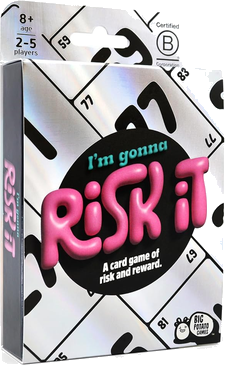
Players: 2–5 | Ages: 8+ | Play time: about 15 minutes
There is exactly one rule: the card you take has to be higher than the card you took last. That’s it. You keep going as long as you dare, and the moment you can’t beat your own last card, you’re out and you lose the lot.
So every single turn is the same question, and it never stops being interesting. You’re sitting on four cards and the next one is a 63. Do you bank what you’ve got, or do you go again and hope? The player with the most cards at the end wins, so playing scared loses just as reliably as getting greedy.
It takes the top spot because it does what almost nothing else on this list manages: it teaches in one sentence, it plays in fifteen minutes, and it still has real decisions in it. If you like Uno but you’ve worn it out, this is the upgrade. It’s also genuinely pocket-sized.
Pros
- One rule, so you can teach it across a table in ten seconds
- Every turn is a genuine decision, not a dice roll
- Pocket-sized, so it goes everywhere
Cons
- Caps at 5 players
- Push-your-luck means the cards can simply desert you
- Light on theme if you want a game with a world to it
Pounce
Best Word Game
Shout a word that fits the category and one of the letters. Just don’t be last.
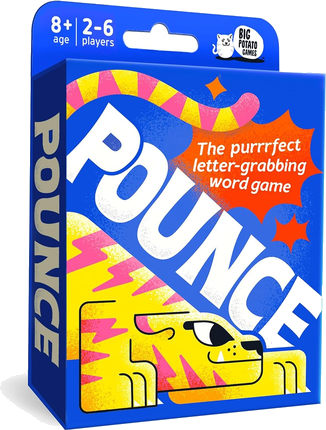
Players: 2–6 | Ages: 8+ | Play time: about 15 minutes
Letters go out on the table and a category comes up. You shout a word that fits the category and starts with one of those letters, then grab that letter card. Collect letters until you can spell a five-letter word out of them, and you’ve won.
The clever bit is the scoring, and it’s why this works with a mixed table. Every player takes a card each round except the slowest one. So you’re not racing to be first, you’re just racing not to be last, which keeps the quick thinkers from running away with it and keeps everyone else in the game.
It takes the word-game slot because it asks for vocabulary under pressure without ever feeling like a test. There’s no spelling bee energy here. You just need one word, fast, and the categories run broad enough that a ten-year-old and their grandpa both stand a real chance.
Pros
- Only the slowest player misses out, so nobody gets left behind
- Rewards vocabulary without punishing anyone for not having it
- Categories range wide enough for a genuinely mixed-age table
Cons
- Caps at 6 players
- It’s a shouting game, so not one for a quiet car ride
- Confident spellers still have an edge
Sounds Fishy
Best for Big Groups
One person has the real answer. Everybody else is making theirs up on the spot.
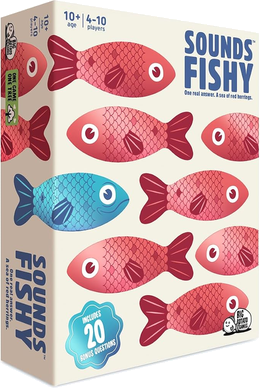
Players: 4–10 | Ages: 10+ | Play time: about 20 minutes
A question gets read out that nobody in the room could reasonably know. One player is the guesser. Of everybody else, exactly one gets handed the real answer on a card. The rest get nothing and have to invent something that sounds just as plausible.
Then you go around the table saying your answers out loud, and the guesser has to work out which one is real. Nothing gets written down, so it moves fast and plays fine with people on their feet. Knowing things isn’t the skill here. Selling something is, and a kid with a straight face beats an adult who over-explains almost every time.
Reach for this one when your group has outgrown most card games. Plenty of games claim ten players and then turn into a slog. This one gets better, because more players just means more fake answers to wade through.
Pros
- Really does scale to 10 players without dragging
- No general knowledge needed, so mixed-age tables stay level
- Nothing to write down, so it keeps moving and works standing up
Cons
- Needs at least four players so there are enough fakes in play
- Somebody’s the guesser each round, so they sit out the bluffing
- Quieter groups take a round or two before the lies get bold
Just One
Best Cooperative Card Game
Everyone writes one clue. Any duplicates get thrown away before the guesser sees them.
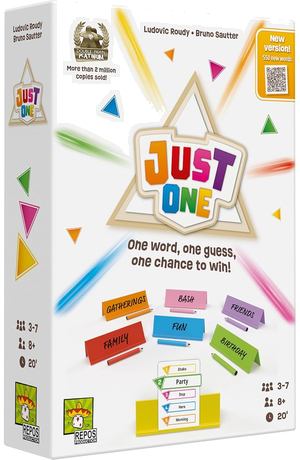
Players: 3–7 | Ages: 8+ | Play time: about 20 minutes
One player is the guesser and doesn’t see the mystery word. Everybody else secretly writes a single word to help them, on the little dry-erase holders that come in the box. Then the clever bit: any clue two or more people wrote gets tossed before the guesser looks. So the obvious clue is worthless, and you have to find the useful word nobody else will land on.
You’re all on the same team, which changes the whole mood. Nobody gloats. The table just winces together when three people write the same thing and cancel out the only good clue available.
It’s the warmest game here, and the one to pick if your group includes somebody who doesn’t enjoy competition. It also plays well at three, which most party card games don’t.
Pros
- Fully cooperative, so nobody is knocked out or singled out
- Works at three players, unusual for a party card game
- Simple enough for eight-year-olds, clever enough for adults
Cons
- Caps at 7 players
- Needs the markers and holders, so you’re sitting down for it
- Rounds are short, which can feel slight next to a bluffing game
Sushi Go
Best Quick Filler
Pick a card, pass the rest, quietly ruin someone’s dessert plans.
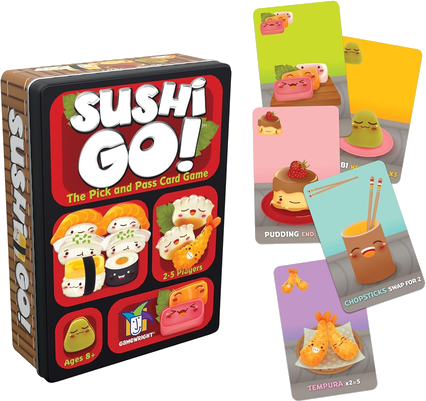
Players: 2–5 | Ages: 8+ | Play time: about 15 minutes
You get a hand of sushi cards, keep one, and pass the rest to the player next to you. Then again, and again, until the cards run out. Sashimi sets score big, but only if you finish three. Dumplings scale up the more you collect. Puddings only score at the very end, and only against everybody else.
This is the most tactical game on the list. There’s real skill in tracking what you just passed along and figuring out what’s coming back around to you. It stays quick because everybody plays at the same time.
Save it for the twenty minutes before the main event, or the twenty minutes after somebody’s gone home and you’re down to three. It’s small, quick, and reliable.
Pros
- Everyone plays at the same time, so there’s no waiting around
- Real tactical depth in a fifteen-minute game
- Works at two players, which most of this list doesn’t
Cons
- Quiet and heads-down, not a game that fills a room with noise
- Scoring takes a minute to explain properly
- Caps at 5 players
P for Pizza
Best for Travel
Shout the answer, win the slice, build the most ridiculous pizza at the table.
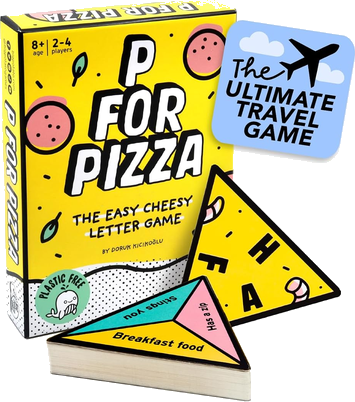
Players: 2–4 | Ages: 8+ | Play time: about 15 minutes
Two cards flip: a letter on one, a category on the other. First person to shout something that fits both takes the card. A bald celebrity starting with B. String instrument starting with G. Food starting with P, which is where the name comes from, and which is way harder than it sounds with four people yelling over each other.
If that sounds like Pounce, the difference is what you’re collecting and how you win. Here the cards are triangles that stack into a giant pizza slice in front of you, and nine of them wins. Categories are color-coded by difficulty, and that decides where a card can sit in your slice, so grabbing the easy ones fast isn’t automatically the play.
It takes the travel slot because the whole game is a small stack of triangular cards in a small box. It fits a coat pocket, works on a tray table, and needs no writing, no board and no space. A group of eight-year-olds will also beat you at it.
Pros
- Small enough for a pocket, so it actually gets taken places
- No writing, no board, no setup at all
- Kids beat adults regularly, which keeps everyone in it
Cons
- Caps at 4 players, where Pounce goes to 6
- Loud by design, which is not a plane-friendly quality
- Fast thinkers have a real edge
Muffin Time
Two hundred and fifty cards of runaway trains, exploding turtles and homicidal potatoes.
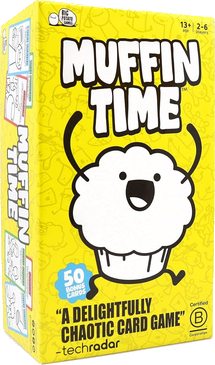
Players: 2–8 | Ages: 13+ | Play time: about 20 minutes
The goal is simple: collect and keep ten cards. Getting there isn’t. The deck is 250 cards of traps, actions, and counters, all built to take your stuff or undo your plan. You’ll get to nine cards and lose four of them in one turn.
It comes out of asdfmovie, the long-running YouTube series, and the humor is exactly that: runaway trains, exploding turtles, homicidal potatoes. If your table gets the reference it lands twice as hard. If they don’t, it still plays as a very silly card game.
No award here, since it’s a specific taste rather than a safe universal pick. But if your group skews teenage or twenties, it’ll probably be the most-requested game on the list.
Pros
- Counter cards mean you are never just sitting there waiting
- Plays 2 to 8, so it covers a duo and a full table
- Includes the expansion packs in the box
Cons
- Rated 13+, and the humor is aimed at teens and young adults
- Take-that card play annoys people who hate being targeted
- Funnier if you already know asdfmovie
How the best card games compare
Push your luck (I’m Gonna Risk It) vs think fast (Pounce)
These are the two best card games here for opposite kinds of player. Risk It is slow and agonizing: one decision a turn, and the tension is entirely in your own nerve. Pounce is the reverse, all reflex and shouting, with no time to think at all.
Verdict: Go with Risk It if your group likes a game they can be clever at. Go with Pounce if you’d rather the table was loud and nobody had to concentrate.
Cooperative (Just One) vs competitive (Sushi Go)
Just One puts everybody on the same side and the failures are collective, so nobody’s left exposed. Sushi Go is quietly cutthroat. You’re handing your opponents a hand of cards and choosing what to deny them, and it comes down to a couple of points at the end.
Verdict: Go with Just One when somebody in the group doesn’t enjoy competition, or when you want the mood to stay warm. Go with Sushi Go when your group wants something they can get better at.
Two word games, one table: Pounce vs P for Pizza
These are the closest pair on the list, so it’s worth being clear. Both flip a letter and a category and ask you to shout something that fits. Pounce has you collecting letters until you can spell a five-letter word, plays up to 6, and only penalises the slowest player each round. P for Pizza has you stacking triangular cards into a giant pizza slice, caps at 4, and color-codes its categories by difficulty.
Verdict: Go with Pounce for a bigger or older group, and because nobody gets shut out. Go with P for Pizza if the table skews young and kids want something to build.
How we chose the best card games
We weighted four things. First, how fast a game teaches, because anything that takes longer than about two minutes to explain loses the room. Second, how well it scales, since a game that claims ten players and then crawls at eight isn’t a ten-player game. Third, whether it works for people who say they don’t play games, since that’s usually at least one person at the table. Fourth, whether the box is still coming off the shelf six months later.
We also held a line on what counts. Plenty of roundups pad this category with games that happen to contain cards, and we cut two of our own on that basis: The Chameleon needs dice and topic boards, and Cards vs Gravity is really a balancing game. Good games, wrong list.
Availability got checked properly too, which ruled out two more we wanted. The Mind has no English-language UK edition, and Monikers only sells in the UK as an expansion rather than a base game. Player counts and age ratings come from each publisher’s current listing rather than third-party databases, which disagree with the box more often than you’d think.
Big Potato Games owns this site, and five of the seven picks are ours. That’s a heavier lean than we’d normally run, and it’s mostly because this category is full of games we make. The cons on those entries are real cons, two of the six awards go to games we didn’t make, and where a competitor is better for a specific job, like Sushi Go at two players or Just One for a group that hates competing, we’ve said so.
Player counts and age ratings checked against Big Potato Games, Czech Games Edition, Gamewright, Asmodee.
Best card games: frequently asked questions
What’s the best card game for a big group?
For a big group, Sounds Fishy is the pick. It handles 4 to 10 players and actually improves as the numbers climb, because more players just means more fake answers for the guesser to wade through. Muffin Time plays 2 to 8 and suits a younger or rowdier group, and Pounce covers 2 to 6 without ever shutting the slower players out. Skip I’m Gonna Risk It, Just One, Sushi Go and P for Pizza once you’re past six: they cap at 5, 7, 5 and 4 respectively. For a big night, grab one of the best card games that scales and add a quick filler for when the group thins out later on.
What are good card games for adults that aren’t just drinking games?
Plenty, and most of them are more replayable. I’m Gonna Risk It (2 to 5 players, ages 8+) is the one with real decisions in it, and adults tend to take the push-your-luck part far more seriously than kids do. Muffin Time (2 to 8, ages 13+) is the chaotic option, built around trap and counter cards and aimed squarely at teens and young adults. Sushi Go (2 to 5, ages 8+) has genuine tactical depth if you want a game you can improve at. And Pounce (2 to 6, ages 8+) is the one for a table that likes words without wanting a quiz. All four work sober and none of them lean on shock value to be funny.
What card game is easiest to teach someone who doesn’t play games?
I’m Gonna Risk It, and it isn’t close. There’s one rule: the card you take has to be higher than your last one. You can teach that across a table in ten seconds and start playing immediately. After that, Pounce is just shouting a word that fits a category and a letter, and P for Pizza works the same way. Don’t make Sushi Go somebody’s first game, because the scoring needs a proper explanation before anyone can play it well, and Just One asks a newcomer to write a clever clue under pressure before they’ve seen a round.
What’s the best card game to take on vacation?
P for Pizza (2 to 4 players, ages 8+) is the best travel pick. It’s a small stack of triangular cards, it needs no writing, no board and no table space, and it plays in about fifteen minutes. I’m Gonna Risk It is just as portable and even simpler, so it’s the better choice for two people on a train. Pounce is the one to pack if there are more of you, since it goes to 6. Leave Just One at home: it needs table space and components beyond the cards.
Are card games good for family game night with mixed ages?
The good ones are, because they level the field in ways board games often don’t. Pounce is built for it: every player takes a card each round except the slowest, so the quickest thinker can’t run away with the game. Sounds Fishy (ages 10+) is the strongest pick once kids are a bit older, since winning comes down to bluffing convincingly rather than knowing facts. I’m Gonna Risk It, P for Pizza, Just One and Sushi Go are all 8+ and work from there. Muffin Time is rated 13+, so save that one for an older table.
If you take one thing off this list, make it I’m Gonna Risk It. One rule, ten seconds to teach, and it still has you agonizing over whether to go again. Add Pounce for the backpack, Sounds Fishy once your group clears eight, and you’ve got the best card games covered for pretty much any game night that comes up.