Best Stocking Stuffer Games (2026)
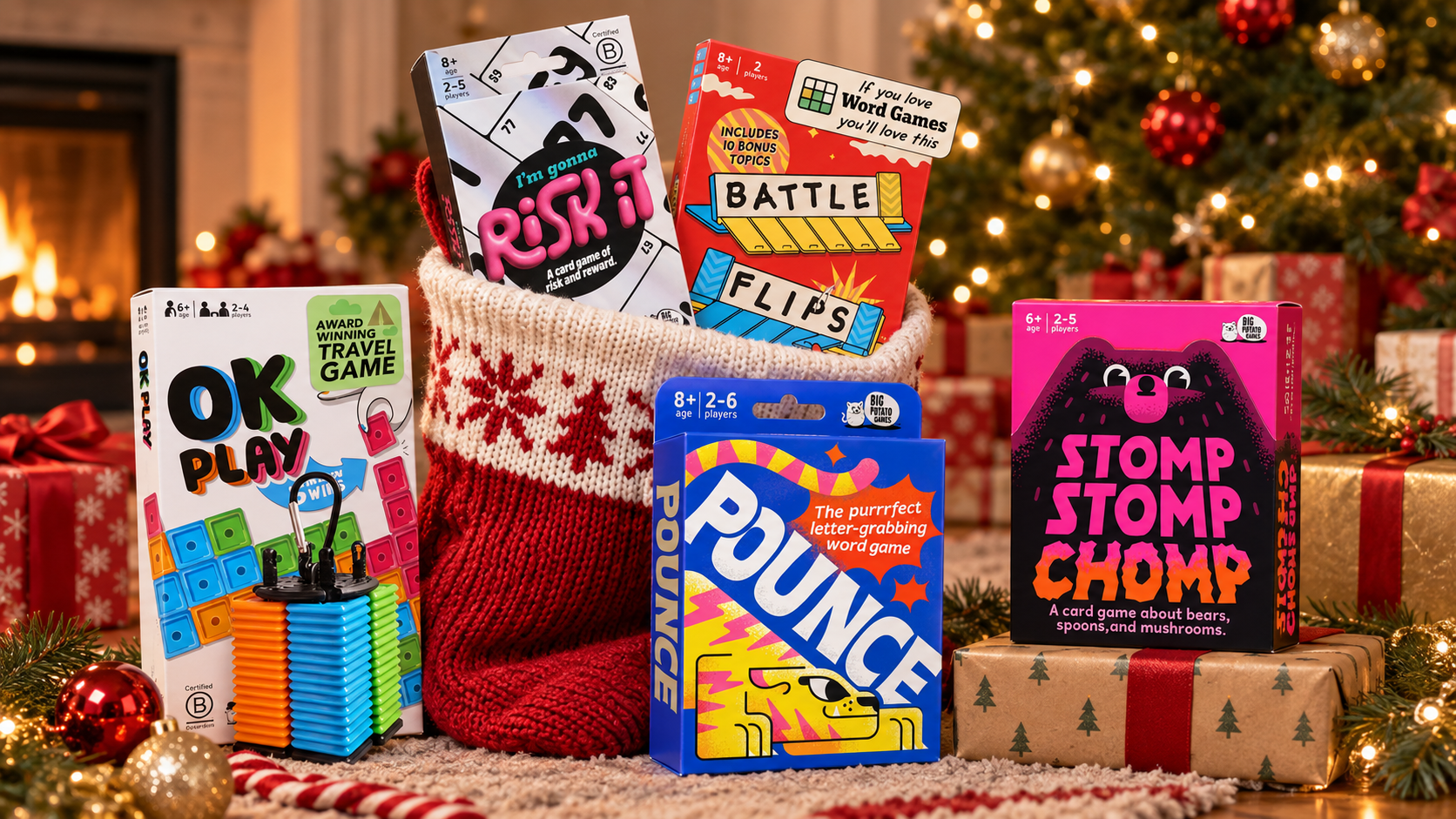
The best stocking stuffer games are cheap, small, and playable the same morning they’re opened. Pounce and I’m Gonna Risk It are the two to reach for first, both around ten dollars and both teachable in under a minute. If you’re filling a kid’s stocking, Stomp Stomp Chomp. If it’s for a couple, Battle Flips.
A stocking stuffer has a harder job than it looks. It has to be small enough to actually fit. It has to be cheap enough that you can buy five. And it has to be good enough that it doesn’t get abandoned by New Year. Most things clear the first two bars and fail the third.
Games are the exception, if you pick the right ones. A small box of cards costs less than a bottle of wine and weighs nothing. Better still, it gets opened and played rather than shelved. The best stocking stuffer games also teach in about a minute, because nobody wants to read a rulebook on Christmas morning.
These eight all come in under twenty dollars, all fit in one hand, and all get playing within a minute of the wrapping coming off. Six are ours and two aren’t, which we’ll come back to.
The eight picks at a glance
- Best Overall Stocking Stuffer: Pounce
- Easiest to Learn: I’m Gonna Risk It
- Best for Kids: Stomp Stomp Chomp
- Best Value Pick: Sushi Go
- Best for Teens and Up: Anomia
- Best for Travel: OK Play
- Also great: Battle Flips
- Also great: Cards vs Gravity
Pounce
Best Overall Stocking Stuffer
Shout a word that fits the category and one of the letters. Just don’t be last.
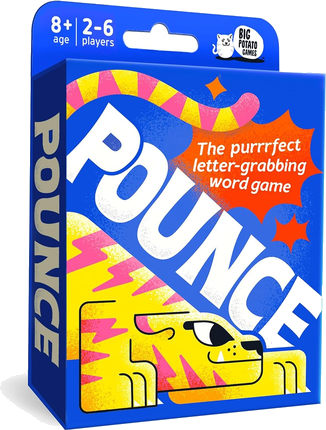
Players: 2–6 | Ages: 8+ | About $10 / £10
Letters go out on the table and a category comes up. You shout a word that fits the category and starts with one of those letters, then grab that letter card. Collect letters until you can spell a five-letter word out of them, and you’ve won.
It takes the top spot because it’s the one most likely to get played twice on Christmas Day. It’s about ten dollars and the size of a deck of cards. The scoring is unusually kind, too: every player takes a card each round except the slowest one. So the fastest thinker can’t run away with it, and nobody gets shut out. That matters when the table is three generations deep.
Categories run broad enough that a ten-year-old and their grandpa both stand a real chance. That’s a rarer quality than it sounds.
Pros
- About ten dollars and the size of a card deck
- Only the slowest player misses out each round, so nobody gets left behind
- Works across a genuinely mixed-age table
Cons
- Caps at 6 players
- It’s a shouting game, so not one for a quiet room
- Confident spellers still have an edge
I’m Gonna Risk It
Easiest to Learn
One rule: your next card has to be higher than your last. That’s it.
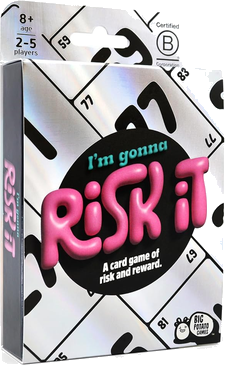
Players: 2–5 | Ages: 8+ | About $10 / £10
There’s exactly one rule: the card you take has to be higher than the card you took last. You keep going as long as you dare, and the moment you can’t beat your own last card, you’re out and you lose the lot.
That makes it the easiest game here to get going on Christmas morning. Nobody has the patience for a rulebook, and half the room is still in a robe. You explain it in one sentence and start playing.
It’s also about ten dollars and genuinely pocket-sized, so it’s the one to buy several of. If somebody in the family likes Uno but has worn it out, this is the upgrade.
Pros
- One rule, so you can teach it in ten seconds flat
- Every turn is a real decision, not a dice roll
- Cheap enough to buy three of
Cons
- Caps at 5 players
- Push-your-luck means the cards can simply desert you
- Light on theme if you want a game with a world to it
Stomp Stomp Chomp
Best for Kids
Flip cards, roll dice, dive for the spoons, turn into a bear.
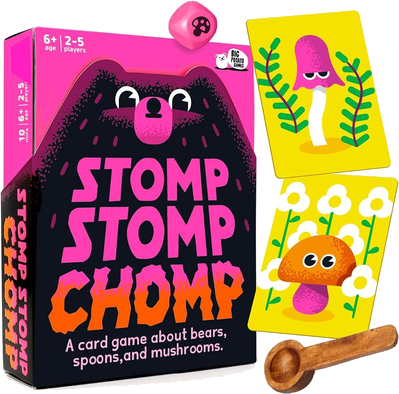
Players: 2–5 | Ages: 6+ | About $12 / £12
You flip cards, roll dice, chant “Stomp, Stomp, Chomp!” and then scramble for the spoons in the middle of the table. Somewhere in there you turn into a bear. It is exactly as silly as it sounds and six-year-olds lose their minds over it.
What makes it a good gift rather than just a good kids’ game is that adults will actually play it. It’s quick, it’s loud, and the diving-for-spoons part puts everyone on a level regardless of age.
One detail worth knowing if the stocking belongs to somebody less inclined to launch themselves across the table: the rules include a sit-down version, so grandparents and anyone with a bad back can still play properly.
Pros
- Ages 6+, so it works for the youngest stocking on the list
- A sit-down variant is built into the rules for anyone not diving for spoons
- Pocket-sized box that survives a holiday
Cons
- In the US it’s a Walmart exclusive, so you can’t grab it on Amazon
- Genuinely chaotic, which is the point but not for every room
- Caps at 5 players
Sushi Go
Best Value Pick
Pick a card, pass the rest, quietly ruin someone’s dessert plans.
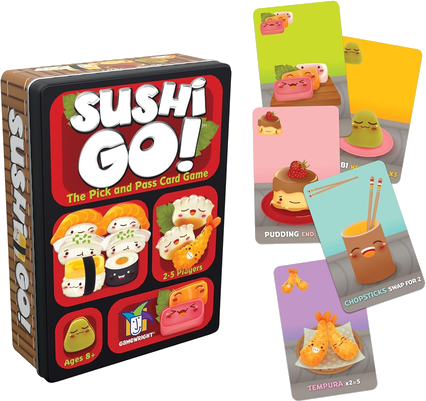
Players: 2–5 | Ages: 8+ | About $12 / £13
You get a hand of sushi cards, keep one, and pass the rest to the player next to you. Then again, until the cards run out. Sashimi sets score big, but only if you finish three. Puddings only score at the very end, and only against everybody else.
It’s the best value on this list at around twelve dollars, and it’s the one with genuine strategy in it. There’s real skill in tracking what you passed along and working out what’s coming back around.
It’s also the quietest game here, which is worth something on a day when the house is already loud. Everyone plays at the same time, so nobody’s waiting.
Pros
- Around twelve dollars for a game with real depth
- Everyone plays at once, so there’s no waiting around
- Works at two players, which most of this list doesn’t
Cons
- Scoring takes a minute to explain properly
- Quiet and heads-down rather than a party game
- Caps at 5 players
Battle Flips
Predict their word before they predict yours. Just the two of you.
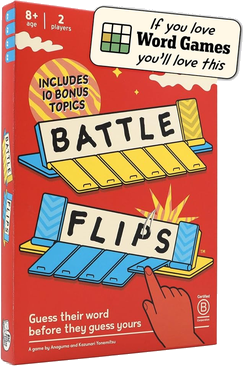
Players: 2 | Ages: 8+ | About $15 / £15
Plenty of games claim to work with two and are quietly better with four. This one is built for two and nothing else. That makes it the right gift for a couple, a pair of siblings, or anyone who mostly plays across a kitchen table rather than at a party.
It’s a slow, tactical word duel. You’re picking obscure words, watching what your opponent commits to, and trying not to give anything away. The racks snap shut and fold flat, which makes cheating hard and packing easy.
It comes with its own travel bag, so it’s the one to put in a stocking if the recipient is going somewhere in January.
Pros
- Designed for exactly two players rather than tolerating them
- Racks fold flat and it ships with a travel bag
- Rewards patience over speed, which is rare in this price bracket
Cons
- Two players only, so it’s no good for a full room
- Slower than everything else here
- Word-game fans will get far more out of it
Anomia
Best for Teens and Up
Two symbols match and suddenly everyone’s shouting a brand of toothpaste.
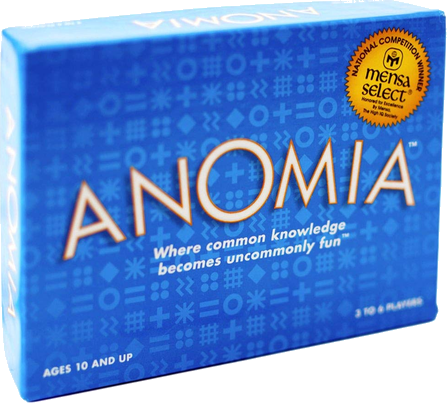
Players: 3–6 | Ages: 10+ | About $18 / £13
Everybody flips cards into their own pile. When the symbols on two players’ cards match, those two race to shout an example of the category on their opponent’s card. Not their own card. Their opponent’s. That small switch is what breaks people’s brains.
It’s the one on this list that turns otherwise articulate adults into someone who cannot name a single breakfast cereal under pressure. Two decks, 92 category cards, and a box that’s genuinely 5.5 by 4 inches.
It’s from Anomia Press, a small US publisher, rather than one of the big names, and it’s been quietly recommended by everyone from The New York Times to Shut Up & Sit Down since 2010.
Pros
- The opponent’s-category twist is genuinely funny to watch
- Tiny box, properly travel-sized
- Holds up with teenagers and adults equally
Cons
- Needs at least 3 players, so no good for a couple
- Rated 10+, the oldest starting age here
- Pricier in the US than the UK at around eighteen dollars
OK Play
Best for Travel
Lay tiles, get five in a row. Learn it in ten seconds, lose to a child in twenty.
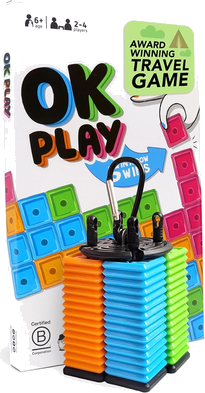
Players: 2–4 | Ages: 8+ | About $19 / £15
Everyone takes a stack of colored tiles and takes turns laying them down, racing to get five in a row. Horizontal, vertical or diagonal, all count. Each tile has to line up flat against another, so no sneaky corner-to-corner placements.
There’s no board, no dice and nothing small to lose, which is why this is the travel pick. The tiles are waterproof and close to indestructible, and the whole thing clips onto a bag. It has survived beaches and been thrown in more than one suitcase.
It’s the only genuinely strategic game here. Seconds to learn, and then it quietly gets deeper the more you play. That’s why it’s picked up a Parent’s Choice Award and a Best Family Game nod. Expect to lose to a nine-year-old.
Pros
- Waterproof and close to indestructible, so it survives being packed badly
- No board, dice or small pieces to lose
- Actually strategic, unlike most games this size
Cons
- The priciest pick here at around nineteen dollars
- Caps at 4 players
- Quiet and thoughtful rather than a party game
Cards vs Gravity
Balance cards on a bottle until somebody’s hand shakes.
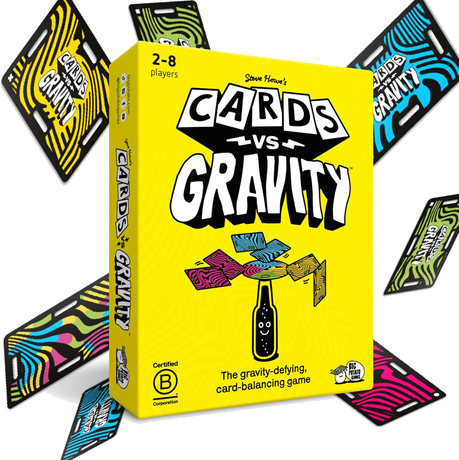
Players: 2–4 | About $17 / £15
Take a bottle, any bottle, and start balancing, hanging and stacking cards on it. The structure gets taller and dumber, everybody starts holding their breath, and eventually somebody knocks the whole thing over.
It earns its place on Christmas Day specifically because there’s always a bottle on the table by the evening. It needs no setup and no explanation, and it works when everyone has eaten too much to concentrate on anything with rules.
The cards are waterproof, and each type carries a symbol as well as a color, so it works if somebody at the table is color blind. No award here, since it’s a filler rather than a main event. It’s still the best ten minutes on the list.
Pros
- Learns in one sentence and needs no reading
- Waterproof cards that survive a drink being spilled on them
- Works with any bottle already on the table
Cons
- It’s a filler, not a whole evening
- Needs a steady surface, so not one for the car
- Caps at 4 players in the standard pack
Choosing between these stocking stuffer games
Two ten-dollar picks: Pounce vs I’m Gonna Risk It
These are the two cheapest games here and the two most likely to get opened and played immediately. Pounce is loud and social, built on shouting words against a category. Risk It is quiet and tense, one decision a turn, and it works just as well with two people as five.
Verdict: Go with Pounce if the stocking belongs to someone who’ll play with a room full of family. Go with Risk It if it’s for one or two people who like a game they can be clever at.
For a kid or for a couple: Stomp Stomp Chomp vs Battle Flips
Stomp Stomp Chomp is the youngest game on the list at 6+, and it’s deliberately chaotic: dice, chanting and a scramble for spoons. Battle Flips is the opposite, a slow two-player word duel with fold-flat racks and a travel bag.
Verdict: Go with Stomp Stomp Chomp for a child’s stocking, remembering it’s a Walmart exclusive in the US. Go with Battle Flips for a couple, or anyone who plays games across a kitchen table rather than at a party.
If you want something that isn’t ours: Sushi Go vs Anomia
Sushi Go is the quiet one. Everybody drafts and passes at the same time, and the skill is in tracking what you handed over. Anomia is the opposite: cards flip, symbols match, and two people start yelling categories at each other. One rewards thinking ahead, the other punishes it.
Verdict: Go with Sushi Go for around twelve dollars and a game with real strategy in it. Go with Anomia if the stocking belongs to a teenager or an adult who enjoys watching their friends malfunction.
How we chose these stocking stuffer games
We set three bars. It has to genuinely fit in a stocking, so nothing bigger than a hand. It has to come in under twenty dollars, because most people are buying several. And it has to be playable within a minute of being unwrapped, since nobody reads a rulebook on Christmas morning.
That last one rules out more than you’d think. A lot of small, cheap games are small and cheap because they’re slight, and they get played once. Every pick here has been opened, taught and played again the same day.
Prices and player counts come from each publisher’s current listing, checked in both the US and the UK. Big Potato Games owns this site and six of the eight picks are ours, which is a heavier lean than we’d normally run. It’s mostly because pocket-sized games are what we make. Sushi Go and Anomia are here because they genuinely belong on the list, and both are better than anything of ours at what they do: Sushi Go for tactical depth at twelve dollars, Anomia for turning grown adults into people who can’t name a cereal.
Player counts and age ratings checked against Big Potato Games.
Stocking stuffer games: frequently asked questions
What makes a good stocking stuffer game?
Three things. Size, because it has to physically fit, which rules out anything bigger than your hand. Price, since most people are buying several stockings’ worth, and ten to twenty dollars is the sweet spot. And speed of teaching, because the best stocking stuffer games get played on Christmas morning rather than shelved for later. I’m Gonna Risk It has one rule and takes ten seconds to explain. Pounce and Stomp Stomp Chomp are both moving within a minute. Anything that needs a rulebook read aloud has already lost the room.
What’s the best stocking stuffer game for a child?
Stomp Stomp Chomp, which is rated 6+ and the youngest game on this list. Players flip cards, roll dice, chant, and race to grab spoons from the middle of the table, and there’s a calmer sit-down version in the rules for anyone who doesn’t want to dive for them. It plays 2 to 5 and costs about twelve dollars. In the US it’s a Walmart exclusive, so you won’t find it on Amazon. For slightly older kids, Pounce (8+) and OK Play (8+) both work well, and kids tend to beat their parents at OK Play within a few games.
Are there good stocking stuffer games for two people?
Battle Flips is built for exactly two and nothing else, which is unusual. It’s a slow word duel where you’re trying to predict your opponent’s word before they predict yours, with racks that snap shut and fold flat, plus its own travel bag. About fifteen dollars. I’m Gonna Risk It (2 to 5 players) also works very well with just two, and Sushi Go is one of the few drafting games that genuinely holds up head to head. Avoid Anomia and Stomp Stomp Chomp as two-player games: Anomia needs at least three, and Stomp Stomp Chomp is better with a crowd.
Which stocking stuffer game is best for traveling?
OK Play. The tiles are waterproof and close to indestructible, there’s no board or dice to lose, and the whole thing clips onto a bag. It plays 2 to 4, ages 8 and up. Battle Flips is the other strong travel pick since it ships with a travel bag and the racks fold flat, though it’s two players only. Anomia is genuinely tiny at 5.5 by 4 inches, and Pounce and I’m Gonna Risk It are both small packs of cards that survive a suitcase. Cards vs Gravity needs a steady surface, so save that one for a table.
What’s a good stocking stuffer game that isn’t from a big brand?
Anomia is the pick. It’s from Anomia Press, a small US publisher, and it’s been quietly recommended since 2010 by everyone from The New York Times to Shut Up & Sit Down. Players flip cards until two symbols match, then race to name an example of the category on their opponent’s card, which is far harder than it sounds. It plays 3 to 6, ages 10+, and the box is genuinely tiny. Sushi Go from Gamewright is the other one worth knowing: about twelve dollars, 2 to 5 players, and more tactical than anything else at that price.
If you’re buying one, make it Pounce: about ten dollars, the size of a card deck, and the rare game where the slowest player still takes something home. Add I’m Gonna Risk It for the stocking that needs a game taught in ten seconds, and Stomp Stomp Chomp if there’s a six-year-old in the house.