The best party game at Walmart right now is Herd Mentality, because it is the only one here that plays properly at four people and at twenty. If the room wants to be on its feet rather than round a table, Chicken vs Hotdog is the pick, and The Chameleon is the one for a group that would rather argue than move.
Walmart’s game aisle is a strange mix. Half of it is the same six boxes that have been there since the nineties, and the other half turns over constantly with whatever is doing numbers online. The good stuff is in there, it is just sat next to nine editions of Monopoly.
A party game has a narrower job than a board game. It has to teach in about a minute, survive people talking over the rules, and work with however many people actually turned up. Anything that needs a quiet table and forty minutes of attention is a different purchase.
These nine are all stocked at Walmart in the US, with the player count and age for each so you can match one to your room.
The picks at a glance
- Best Overall: Herd Mentality
- Best for Bluffing: The Chameleon
- Best Action Game: Chicken vs Hotdog
- Best Head-to-Head: Tilt ‘n’ Shout
- Best Cheap Pick: I’m Gonna Risk It
- Best for Younger Kids: Stomp Stomp Chomp
- Best for Teens: You Laugh You’re Out
- Also great: Marshmallow Madness
- Also great: Yeti in My Spaghetti
Herd Mentality
Best Overall
Don’t be clever. Be the same as everyone else.
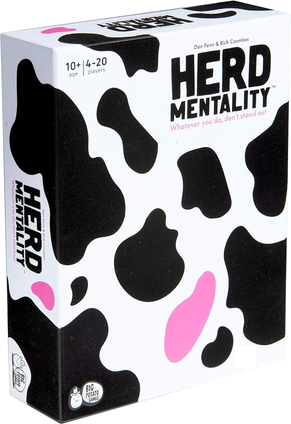
Players: 4–20 | Ages: 10+ | Play time: about 20 minutes
A question gets read out. Everyone writes their answer down in secret, then you all reveal at once. You score a cow token if your answer matched the majority of the table, and nothing at all if it didn’t. Get it wrong entirely on your own and you’re handed the Pink Cow, which you keep until somebody else slips up.
The twist is that being right is worthless. The question might be “name a breakfast food” and the correct answer, the useful answer, is whichever one your uncle is most likely to have written. You spend the whole game second-guessing people you thought you knew, and the funniest moments come from someone giving a completely sincere answer that nobody else shares.
It takes the top spot because of the range. Four players works, twenty works, and it is one of very few games that genuinely does not break at either end. That makes it the one to keep in the cupboard for the gathering where you don’t know the final headcount until people are through the door.
Pros
- Scales from 4 to 20 without changing how it plays
- No knowledge needed, so kids and grandparents compete evenly
- Rounds are short, and you can join partway through
Cons
- Needs at least four players to have a majority
- Everyone writes, so it wants a table or a hard surface
- Very quiet groups take a round or two to open up
The Chameleon
Best for Bluffing
Everyone knows the secret word. One of you is bluffing from nothing.
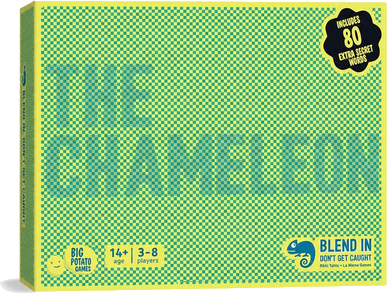
Players: 3–8 | Ages: 12+ | Play time: about 15 minutes
A topic card puts sixteen related words in a grid. A dice roll gives a code pointing at one of them, and every player reads that code except one, who draws the Chameleon card and gets nothing. You go round the table saying a single word about the secret word, then everyone votes. A caught Chameleon still escapes if they can name the word.
The tension is that a good clue and a lucky guess look identical. Say something too specific and you hand the Chameleon the answer. Say something too vague and the table turns on you instead. Most rounds end with somebody confidently voting out an innocent player, which is the bit people remember.
It is the pick for groups who want the argument rather than the activity. There is nothing to assemble, nothing to knock over, and it plays at three, which almost no other bluffing game manages. With 800 topics in the box the words do not start repeating.
Pros
- Teaches in about a minute with no app or moderator
- Plays at three, unusual for a deduction game
- 800 topics, so the words don’t start repeating
Cons
- One clue word each makes rounds short
- A quiet table needs a round or two to loosen up
- The escape guess can sting when you called it right
Chicken vs Hotdog
Best Action Game
Flip a rubber chicken onto a corn cob. That is the entire pitch.
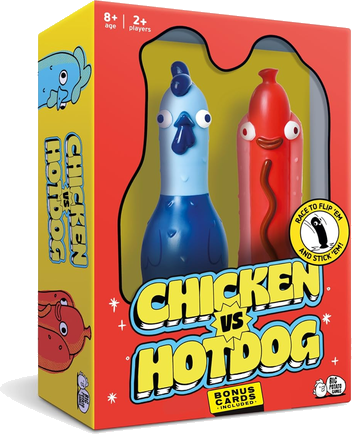
Players: 2–10 | Ages: 8+ | Play time: about 20 minutes
Two teams, one rubber chicken and one rubber hotdog. A card sets the challenge, and you flip, flick and launch your character trying to land it before the other side lands theirs. When it connects it makes a noise the whole room hears, and that noise is most of the appeal.
It is the one that gets people off the sofa. Nobody needs the rules explained twice, there is no reading, and a seven-year-old beating three adults is a completely normal outcome. The skill is real but shallow enough that everybody is competitive within a round.
This is the pick for a mixed-age room that has run out of patience for sitting down. It is also the loudest thing on this list by some distance, which is either the reason to buy it or the reason not to.
Pros
- Understood instantly, with no reading and no setup
- Kids genuinely beat adults at it
- Gets a room standing up and moving
Cons
- Loud, and it is meant to be
- Needs floor or table space to flip across
- Not the one for a quiet evening
Tilt ‘n’ Shout
Best Head-to-Head
Two players, one category, and a ball rolling towards the end of your turn.
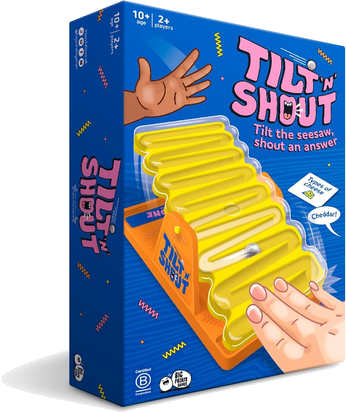
Players: 2–8 | Ages: 8+ | Play time: about 20 minutes
Two players go head to head on a category while the ball rolls along the centrepiece between them. Every answer you shout pushes the momentum back towards your opponent. Stall, and it keeps rolling your way.
It is less a trivia game than a nerve game. The categories are wide enough that you always know several answers, so losing is almost never about ignorance, it is about your brain emptying at the exact moment everyone is looking at you.
Because it is a duel, it is the best thing here for a room that wants to watch. Two people play, everyone else heckles, and the next pair steps up. That structure holds a bigger group’s attention better than a game where eight people are all thinking at once.
Pros
- Head-to-head structure gives everyone else something to watch
- Categories are broad, so it isn’t a knowledge test
- Short rounds, easy to rotate players in
Cons
- Only two people are actually playing at a time
- The physical centrepiece needs a flat surface
- Fast-talkers have a real edge
I’m Gonna Risk It
Best Cheap Pick
One rule. Take a higher card than your last, or lose everything.
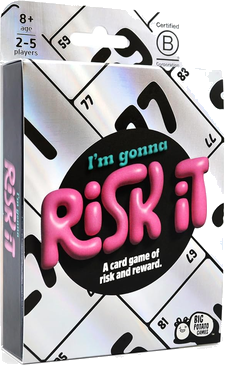
Players: 2–5 | Ages: 8+ | Play time: about 15 minutes
There is exactly one rule: the card you take has to be higher than the card you took last. Keep going as long as you dare. The moment you can’t beat your own last card, you’re out and you lose the lot.
So every turn is the same question and it never stops being interesting. You’re sitting on four cards and the next one is a 63. Bank what you have, or go again? The player with the most cards at the end wins, so playing scared loses just as reliably as getting greedy.
It’s the cheapest thing on this list and the easiest to teach. One sentence and you’re playing, which makes it the filler for the twenty minutes before everyone’s arrived.
Pros
- One rule, so you can teach it across a table in ten seconds
- Every turn is a real decision, not a dice roll
- Pocket-sized, so it goes everywhere
Cons
- Caps at 5 players
- Push-your-luck means the cards can simply desert you
- Light on theme if you want a game with a world to it
Stomp Stomp Chomp
Best for Younger Kids
Flip, chant, and grab a wooden spoon before the bear gets you.
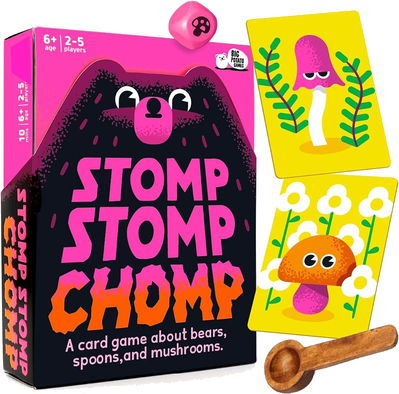
Players: 2–5 | Ages: 6+ | Play time: about 15 minutes
You flip cards, roll the die, chant “Stomp, Stomp, Chomp!” and then scramble for the spoons in the middle of the table. Somewhere in there you turn into a bear. It is exactly as silly as it sounds and six-year-olds lose their minds over it.
The reason it works with mixed ages is that reaction speed is the only skill involved, and a six-year-old’s reactions are not meaningfully worse than an adult’s. There is no reading, no strategy to explain and nothing to remember between rounds.
Worth knowing: in the US this one is a Walmart exclusive, so this is the only place you’ll find it.
Pros
- Rated 6+, the youngest game here
- Pure reaction speed, so young kids compete properly
- Rounds last seconds, so nobody loses interest
Cons
- Grabbing for spoons means a bit of table chaos
- Caps at 5 players
- Adults will get bored before the kids do
You Laugh You’re Out
Best for Teens
Thirty seconds to make them laugh. Laugh yourself and you lose a token.
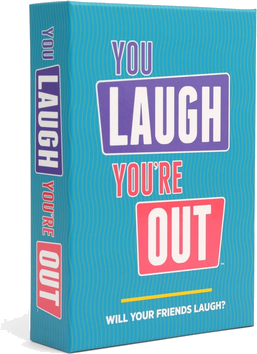
Players: 3–10 | Ages: 14+ | Play time: about 30 minutes
Players draw a prompt card and get thirty seconds to make the rest of the group laugh by acting it out. Anyone who cracks gives up a laugh token, and the first player to run out of tokens loses. There are 125 prompts in the box.
It sits in a slot nothing else here covers, which is why it is on the list. The others are about knowing, guessing or reacting. This one is about keeping a straight face, and it rewards the deadpan person in the group who never wins anything else.
The 14+ rating is worth noting if you are buying for a family with younger kids, since it is the oldest recommendation on this list.
Pros
- Fills the try-not-to-laugh slot nothing else here covers
- 125 prompts in the box
- Rewards deadpan players rather than loud ones
Cons
- Rated 14+, the oldest game on this list
- Runs on performers, so a shy group struggles
- Thirty-second turns mean a lot of sitting and watching
Marshmallow Madness
Tiny plastic hands, a bag of marshmallows, sixty seconds.
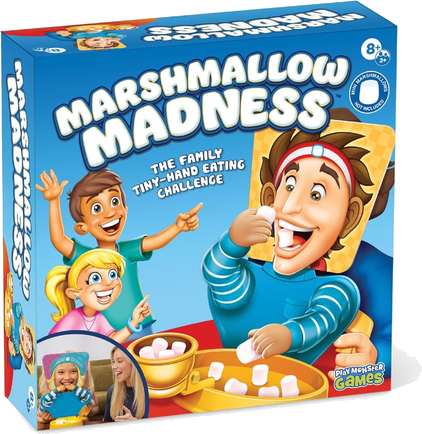
Players: 2+ | Ages: 8+ | Play time: about 15 minutes
You put on a pair of comically small plastic hands, start the timer, and race to get as many marshmallows into your mouth as you can in sixty seconds. Most marshmallows wins. That is genuinely the whole game.
It is here because it is the most watchable thing on the list, and because it needs nothing from the players except willingness. Nobody has to be quick-witted or well-read. You do have to supply the marshmallows yourself.
Treat it as a party stunt rather than a game night game. It will not fill an evening, but it will produce the video everyone sends round the next day.
Pros
- Needs no knowledge, skill or reading at all
- Extremely watchable, so a crowd stays involved
- Open-ended player count
Cons
- You supply the marshmallows
- It is an eating challenge, so supervise younger players
- One joke, and it does not last a whole evening
Yeti in My Spaghetti
Pull a noodle. Don’t drop the yeti.

Players: 2+ | Ages: 4+ | Play time: about 10 minutes
Plastic noodles lie across the top of a bowl with a small yeti balanced on them. Players take turns pulling a noodle out. Drop the yeti and you lose. Setup takes about ten seconds and there is nothing else to explain.
It is the youngest game here by some way, rated 4 and up, and it is on the list because that end of the shelf is genuinely hard to buy for. Most things sold as party games need reading, writing or general knowledge, and a four-year-old has none of those. This needs a steady hand and nothing else.
Adults will be done with it quickly, which is fine. It is the one you put on the table so the youngest person in the room gets a game they can actually win.
Pros
- Rated 4 and up, the youngest game on this list
- Set up and understood in seconds, with no reading
- Small and light enough to travel
Cons
- Adults will lose interest before the kids do
- Rounds are very short
- Plastic noodles are easy to lose down the back of a sofa
Choosing between these Walmart party games
Herd Mentality vs The Chameleon
Both are talking games with nothing to assemble, and they split on group size and edge. Herd Mentality goes to twenty and is entirely good-natured: you are trying to agree with people. The Chameleon caps at eight and is the opposite, built on suspicion and a vote that goes wrong.
Verdict: Take Herd Mentality for a big mixed room, including kids. Take The Chameleon for a smaller group of adults who enjoy accusing each other.
Chicken vs Hotdog vs Tilt ‘n’ Shout
These are the two active picks and they need different rooms. Chicken vs Hotdog is everybody up and flipping at once, and it needs space. Tilt ‘n’ Shout is a duel: two players at the centrepiece while the rest watch and shout.
Verdict: Chicken vs Hotdog for a room with floor space and kids in it. Tilt ‘n’ Shout if you want something watchable that works on a normal table.
Buying for younger kids
Ages on this list run from 6 to 14, and the gap matters more than it looks. Stomp Stomp Chomp is rated 6+ and is pure reaction speed, so young children compete on equal terms. You Laugh You’re Out is 14+ at the other end.
Verdict: Under eight, Stomp Stomp Chomp is the only real option here. From ten upwards Herd Mentality is the safest family buy.
How we chose these Walmart party games
We weighted three things. How fast the game teaches, because anything needing more than about two minutes of explanation loses a party. How well it holds the number of people actually in the room, which is the thing most party games quietly fail at. And whether it works for someone who says they don’t play games, since there is usually one.
We only included games currently stocked at Walmart.com in the US, and we checked each product page directly rather than relying on a feed. Player counts and ages come from the manufacturer’s own listing.
Player counts and age ratings checked against Big Potato Games, DSS Games, PlayMonster.
Party games at Walmart: frequently asked questions
What is the best party game at Walmart?
Herd Mentality, for most rooms. It plays 4 to 20 players from age 10 up, a question is read out, everyone writes an answer in secret, and you only score if you match the majority. The reason it wins is range: very few party games work at both four players and twenty without breaking. If your group is under eight adults and wants something with an edge to it, The Chameleon is the better pick, and if the room wants to be on its feet, Chicken vs Hotdog is.
What party game at Walmart works for a big group?
Herd Mentality is the widest at 4 to 20 players. You Laugh You’re Out handles up to 10 but is rated 14 and up. Tilt ‘n’ Shout technically plays 8 but only two people are active at once, which is a feature rather than a flaw if you want the rest of the room watching and heckling. Avoid anything that caps at 5, like I’m Gonna Risk It or Stomp Stomp Chomp, if a large group is the main use.
Which Walmart party games work for kids?
Stomp Stomp Chomp is rated 6 and up and is the youngest here. It is pure reaction speed, so a six-year-old competes properly against adults, and in the US it is sold exclusively at Walmart. From 8 up, Chicken vs Hotdog and I’m Gonna Risk It both work. Herd Mentality is 10 and up and is the strongest all-family option because nobody needs any general knowledge to play it.
Are there party games at Walmart for under ten dollars?
I’m Gonna Risk It is the smallest box on this list, a push-your-luck card game for 2 to 5 players aged 8 and up with a single rule. Walmart moves prices around through the fall so it is worth checking the page rather than trusting a number written in an article, but the small card games are consistently the cheapest way into this category.
What party game should I buy if I don’t know how many people are coming?
Herd Mentality, without much argument. It plays anywhere from 4 to 20 and does not change shape in between, and players can join partway through a game without anyone reshuffling. Most party games have a narrow band where they work properly and get either slow or thin outside it. This is the main one on the list that does not.
If you are picking one thing off the Walmart shelf, make it Herd Mentality. It handles whatever number of people turn up, it needs no knowledge at all, and it is funny because of what your friends genuinely think rather than because of anything in the box. Add Chicken vs Hotdog if there are kids, and The Chameleon if there aren’t.